Projects
|
FAQ
|
Announcements



#Realized that people are all similar #A new experience; culture shock #It was hard but rewarding

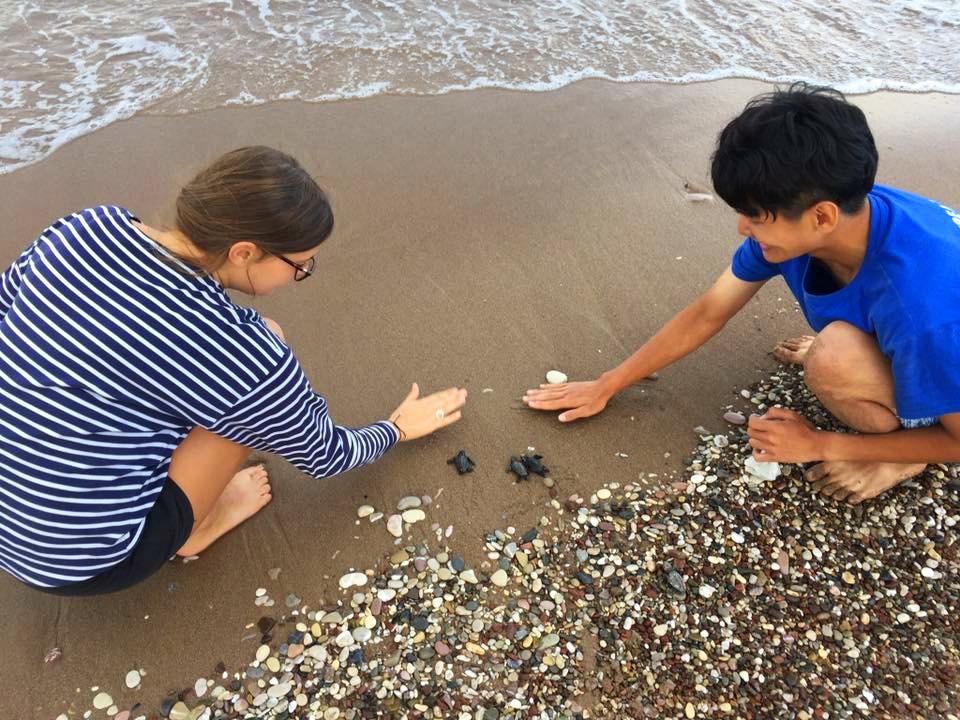
The day before a volunteer leaves, we all eat out together. It''s not in the photo, but we go to the beach to swim, go to the lake, go into town to shop, drink, and at night sit in a circle on the beach and tell dirty stories, etc.I was able to have a lot of unique experiences. -Greece, a rescue operation for injured turtles in the Mediterranean / Lee Ji-yoon, gap year traveler / 4-week gap year |
# I''m so grateful there are projects like this in Gap Year.

The day before a volunteer leaves, we all eat out together. It''s not in the photo, but we go to the beach to swim, go to the lake, go into town to shop, drink, and at night sit in a circle on the beach and tell dirty stories, etc.I was able to have a lot of unique experiences.
Especially the dirty stories — I was so culturally shocked I wondered if I had been a ''gentleman of the East'' (very prim). We still have a Facebook Messenger group chat. Everyone has a nickname; mine is “Aaaaaaa.” They imitate me like “Oh~ I get it haha.” Someone even said they wanted to use my voice instead of Siri and that they''d miss it. The volunteers are a bit peculiar, which is fun.At the end, when I called a taxi to go to the airport and was leaving, everyone came outside and saw me off until I was out of sight — I remember laughing a lot with the taxi driver.

Because we worked closely together every day, there were conflicts: some people cried, some wanted to go home halfway because it was too hard, and various things happened. What I felt was that regardless of nationality, people are basically the same. Those who work, work a lot; those who don''t, don''t. Also, everyone is in the same volunteer position and many act like they''re the expert...It''s an interesting experience.
Because the work is very hard, injured sea turtle volunteering can make you want to quit halfway unless you truly believe you''re working for the turtles. At first I even wondered if I used to be a foreign laborer, haha. After finishing and returning, it was really great — I became completely healthy. On the final island trip I even walked 17 km in a day.

As I was wrapping things up, I also noticed that even when we went out by boat to release turtles, there were plastic bags floating on the sea. I swam over and retrieved them immediately, but each of these items is a threat to life...I was once again made acutely aware of the seriousness of marine litter.
And surprisingly, many of the injured turtles had been hurt by humans, which made me feel that measures are needed. Fishermen would hit their heads because they ruin their nets, or stab their eyes and blind them... Raising public awareness is important, but I think discussions with fishermen, who interact most with sea turtles, need to take place.

After doing this project, I want to try beach projects and going out by boat to the sea to tag turtles. The future is still uncertain, but rather than simply...I don''t want to just do what I wanted to try in life and be done with it — I want to use this experience to keep working with sea turtles going forward~!
I''m so glad Gap Year has projects like this. I''m grateful to the Gap Year team who always kindly helped and cheered me on by email!!
# I''m so grateful there are projects like this in Gap Year.

(Language)
Sob sob — the TOEIC, TEPS, and the Korean SAT we took in Korea were all overly polite versions. It''s not easy to listen to British people who speak like a machine gun yet in a whisper, especially their relaxed, whispery way of speaking. Concentrating on all conversations drains energy, so when everyday talk was too fast and I couldn''t follow, I''d zone out a bit and later ask the others for a summary.
Of course the physical part makes up a large portion, but if you''re good at English you can understand more and have a much wider scope of work. A volunteer who''d been there a while said that someone who came before couldn''t speak much English; even if you explained things verbally they''d smile blankly and not understand at all, so there was nothing to teach them. In that case they mostly got simple manual tasks, so that volunteer must have had a hard time.
There are actually quite a few tasks you learn to do, and for weekend activities you have to give simple tours and explanations in English to visitors to the center. Also, volunteers talk about turtles a lot among themselves like talking about people they know, so...I think you need a certain level of English to follow this quick flow of English conversation.
Oh, and for work-related things, even if you understand them in English, it''s easy to forget, so it''s helpful to take separate notes in Korean!!!

(Accommodation and living)
There was only one male volunteer and the rest were women, and even that male volunteer didn''t make it awkward (sorry Axel) — everyone was comfortable!! From what I heard, usually there are at most three or four men. For rooms you''ll get either a 4-person room next to the communal kitchen or one of the container rooms in the back (a 4-person and a 3-person), and you''ll sleep in whichever bed is empty. The 4-person room next to the communal kitchen has the advantage of a bathroom right next to the kitchen, so it''s convenient for nighttime bathroom trips and you can use Wi‑Fi, but the downside is people coming and going in the kitchen and noise while sleeping.
The container is difficult when going to the bathroom in the middle of the night. Locking and opening the door requires skill and strength. At first I wrestled with it alone for 15 minutes at night and eventually woke another volunteer to go to the bathroom. But the container is quiet and nice for sleeping in on rest days.
And every room has air conditioning!!!! They blast the AC so hard — I set the desired temperature to 17°C and slept, but my roommates get so hot. It was so cold that I slept inside a sleeping bag: it was cold outside but my body stayed warm.

Also, please be aware volunteers will inevitably get a lot of sun exposure. ㅠㅠ There are four work areas: outside tank, greenhouse tank, big tank, and inside tank. Usually two people are assigned to outside and four to the greenhouse to start working. The greenhouse is a bit better, but in both places you end up working fully exposed to the sun.
We usually work about 6–7 hours a day. The sun is intense and it''s extremely hot from the morning, and since we work inside tanks with water, most people work wearing tank tops and hot pants.
After finishing outside and the greenhouse work, we do the inside tasks where there are at most three, so usually the volunteer who finished the greenhouse work does them. And the big tank is by far the hottest and gets the most sun exposure. In short, there''s almost no working indoors. Putting on sunscreen isn''t to avoid tanning; it''s just to prevent getting painfully sunburned.
There was someone—a Korean—who didn''t like getting tanned and worked in long sleeves and long pants in this heat.To be honest, it''s upsetting. I''m writing this because I''m upset... Of course, in Europe tanning means ''I had a good holiday,'' while in our country pale skin is considered beautiful — it''s a cultural difference.
Because of the nature of this volunteer work, temperatures can approach 45°C at the hottest, and since you work with water you''re constantly getting wet.You should be aware that usually people work in very minimal clothing. This volunteer work seems unsuitable for someone who hates getting their skin tanned.

(Meals)
Meals here were a completely individual affair. I had thought vegetarians just didn''t eat meat and ate vegetables, but there are many types. Some eat eggs, some only eat cheese; even non-vegetarians have things they can''t eat. Each person has strict restrictions and varied tastes and diets, so sharing food didn''t look easy.
If you take the tram about three stops, there''s an ABmart, which is the cheapest, so people usually do their shopping there. (Also, every Thursday a street market like Korea''s discount market sets up, where you can buy fruit, vegetables, eggs, etc. cheaply!) Each person has an assigned spot in the fridge and on the shelf to store the food they buy.
For breakfast we usually just wake up and quickly eat cereal, toast, yogurt, fruit, etc., and for lunch and dinner you can cook or go out to eat. My biggest regret was not bringing a single food item from Korea. I thought I eat anything so there was no need for Korean retort or instant foods and that I''d eat fresh local food — I wanted to kick myself.
Here the rice becomes cooked after boiling about 13 minutes, and we mainly ate it like a salad rice. Mix it with cucumber, tomato, fried onions and toss with balsamic or olive dressing, etc. I kept thinking, ''If only I''d brought a tube of gochujang...''

I recommend preparing in advance and bringing any food you can, thinking you''ll be living abroad. Also, Greek food is rustic and doesn''t have the sort of finesse in taste and presentation. For some reason I saw French people never eat out and always cook every meal; I realized Korea is also a foodie country. Still, there''s a wide variety of restaurants just one tram stop away, so you have many eating-out options. You can pack leftovers for the next meal — that''s common in Greece and convenient.
Portions are large. If you''re craving spicy food 100%, go to an Indian curry place and ask for the spiciest — that''ll satisfy you. The cheapest meal is souvlaki, which costs around €2 and is filling; one fills you up. Delivery is available, so we often order together on Sundays. If you ask around you''ll know which place it is — I forgot the name.
One place was nice to eat at — good interior, fish in a tank, and we had a few farewell parties there. It was the best value-for-money souvlaki! In my opinion, the best restaurant in Glyfada is to eliniko. It''s only a few minutes'' walk from the AB store I mentioned earlier. It''s ranked #3 on TripAdvisor; surprisingly reasonable prices and everything is tasty. It''s not rustic. Definitely worth a visit if you''re shopping.
There is also a Chinese place that offers a served buffet for €15, a cheap but tasty pasta place (was it Viva Pasta?), and of course McDonald''s, KFC, Pizza Hut!

(What to bring)
Greek mosquitoes are terrible!! They''re much smaller, quicker, and stronger than Korean mosquitoes! I got bitten three times just while hanging laundry for a moment, and I got bitten while briefly waiting at a traffic light. I''m the type who gets bitten easily so it may vary, but still — mosquito repellent and Balmuri (insect bite relief) are essential!!!!!!!!!!!!
The Balmuri I brought from Korea ran out after 3 or 4 days because of heavy use, so I bought Korres ''After Mosquito'' at a Greek pharmacy, but it felt weak.Korean ones are the best!! If you''re staying for a month, I recommend bringing two Balmuri tubes!!
A handheld fan is also useful. You''ll attract everyone''s attention and envy. The moment I turned mine on people all stared and my friends burst out laughing. It was the most useful item, I realized. Also, it''s fine to buy bikinis and beach towels here!
You can buy bikinis cheaply at places like H&M, and you can get a beach towel for about €10 at the market I mentioned; Greek cotton is famous, so you can get a soft 100% cotton towel. After work it''s nice to just spread it on the beach, lie down and watch the sea, maybe nap; the center also has snorkeling masks, so you can swim and sleep — it''s useful.
If you didn''t bring something you can buy it here! But medicines from Korea are much better. I''m speaking from personal experience, so trust me and bring all your emergency meds!! Strangely I packed four different kinds of stomach medicine but didn''t bring cold medicine and regretted it... I never had stomach trouble though, sigh.

(Leisure)
It said you''d have three days off out of 28, so I expected that amount, but unexpectedly we had two days off a week so much more holiday!! It''s a five-day workweek!!! All volunteers take turns, and you can think of working as AM, PM, and a normal third shift. If a working day falls on a weekend, outdoor activities may be scheduled so the shift could be AM, PM, PA, meaning you''d have two normal days. Since you can spend your days off in many different ways, it''s good to plan ahead.
Because you get two consecutive days off, you can go away for an overnight trip. If work ends early the day before, a 2-night/3-day trip is possible. Nearby beach outings, Athens city tours, and Vouliagmeni Lake (home of the ''doctor fish'') can be done after work with other volunteers even on non-off days, so personally I strongly recommend buying ferry tickets and island-hopping. Greece left me remembering it as a country of islands — there are so many charming islands. I regret not visiting more islands that aren''t well-known to Koreans.
# Life TIP

There is Wi‑Fi here now!!!!!!!! It didn''t exist before. Of course it doesn''t cover the whole center — it works near the communal kitchen and the pop''s office — but that''s something! Speaking of data, I recommend buying a SIM in Greece from Vodafone. Was it 8GB for €15? Prices vary by store so you might get it cheaper. I was amazed that you can live a month with plenty of data for around 20,000 KRW, so on my break I splurged on a YouTube binge.
The day before a volunteer leaves, we all eat out together. It''s not in the photo, but we go to the beach to swim, go to the lake, go into town to shop, drink, and at night sit in a circle on the beach and tell dirty stories, etc.I was able to have a lot of unique experiences. -Greece, a rescue operation for injured turtles in the Mediterranean / Lee Ji-yoon, gap year traveler / 4-week gap year |
# I''m so grateful there are projects like this in Gap Year.
The day before a volunteer leaves, we all eat out together. It''s not in the photo, but we go to the beach to swim, go to the lake, go into town to shop, drink, and at night sit in a circle on the beach and tell dirty stories, etc.I was able to have a lot of unique experiences.
Especially the dirty stories — I was so culturally shocked I wondered if I had been a ''gentleman of the East'' (very prim). We still have a Facebook Messenger group chat. Everyone has a nickname; mine is “Aaaaaaa.” They imitate me like “Oh~ I get it haha.” Someone even said they wanted to use my voice instead of Siri and that they''d miss it. The volunteers are a bit peculiar, which is fun.At the end, when I called a taxi to go to the airport and was leaving, everyone came outside and saw me off until I was out of sight — I remember laughing a lot with the taxi driver.
Because we worked closely together every day, there were conflicts: some people cried, some wanted to go home halfway because it was too hard, and various things happened. What I felt was that regardless of nationality, people are basically the same. Those who work, work a lot; those who don''t, don''t. Also, everyone is in the same volunteer position and many act like they''re the expert...It''s an interesting experience.
Because the work is very hard, injured sea turtle volunteering can make you want to quit halfway unless you truly believe you''re working for the turtles. At first I even wondered if I used to be a foreign laborer, haha. After finishing and returning, it was really great — I became completely healthy. On the final island trip I even walked 17 km in a day.
As I was wrapping things up, I also noticed that even when we went out by boat to release turtles, there were plastic bags floating on the sea. I swam over and retrieved them immediately, but each of these items is a threat to life...I was once again made acutely aware of the seriousness of marine litter.
And surprisingly, many of the injured turtles had been hurt by humans, which made me feel that measures are needed. Fishermen would hit their heads because they ruin their nets, or stab their eyes and blind them... Raising public awareness is important, but I think discussions with fishermen, who interact most with sea turtles, need to take place.
After doing this project, I want to try beach projects and going out by boat to the sea to tag turtles. The future is still uncertain, but rather than simply...I don''t want to just do what I wanted to try in life and be done with it — I want to use this experience to keep working with sea turtles going forward~!
I''m so glad Gap Year has projects like this. I''m grateful to the Gap Year team who always kindly helped and cheered me on by email!!
# I''m so grateful there are projects like this in Gap Year.
(Language)
Sob sob — the TOEIC, TEPS, and the Korean SAT we took in Korea were all overly polite versions. It''s not easy to listen to British people who speak like a machine gun yet in a whisper, especially their relaxed, whispery way of speaking. Concentrating on all conversations drains energy, so when everyday talk was too fast and I couldn''t follow, I''d zone out a bit and later ask the others for a summary.
Of course the physical part makes up a large portion, but if you''re good at English you can understand more and have a much wider scope of work. A volunteer who''d been there a while said that someone who came before couldn''t speak much English; even if you explained things verbally they''d smile blankly and not understand at all, so there was nothing to teach them. In that case they mostly got simple manual tasks, so that volunteer must have had a hard time.
There are actually quite a few tasks you learn to do, and for weekend activities you have to give simple tours and explanations in English to visitors to the center. Also, volunteers talk about turtles a lot among themselves like talking about people they know, so...I think you need a certain level of English to follow this quick flow of English conversation.
Oh, and for work-related things, even if you understand them in English, it''s easy to forget, so it''s helpful to take separate notes in Korean!!!
(Accommodation and living)
There was only one male volunteer and the rest were women, and even that male volunteer didn''t make it awkward (sorry Axel) — everyone was comfortable!! From what I heard, usually there are at most three or four men. For rooms you''ll get either a 4-person room next to the communal kitchen or one of the container rooms in the back (a 4-person and a 3-person), and you''ll sleep in whichever bed is empty. The 4-person room next to the communal kitchen has the advantage of a bathroom right next to the kitchen, so it''s convenient for nighttime bathroom trips and you can use Wi‑Fi, but the downside is people coming and going in the kitchen and noise while sleeping.
The container is difficult when going to the bathroom in the middle of the night. Locking and opening the door requires skill and strength. At first I wrestled with it alone for 15 minutes at night and eventually woke another volunteer to go to the bathroom. But the container is quiet and nice for sleeping in on rest days.
And every room has air conditioning!!!! They blast the AC so hard — I set the desired temperature to 17°C and slept, but my roommates get so hot. It was so cold that I slept inside a sleeping bag: it was cold outside but my body stayed warm.
Also, please be aware volunteers will inevitably get a lot of sun exposure. ㅠㅠ There are four work areas: outside tank, greenhouse tank, big tank, and inside tank. Usually two people are assigned to outside and four to the greenhouse to start working. The greenhouse is a bit better, but in both places you end up working fully exposed to the sun.
We usually work about 6–7 hours a day. The sun is intense and it''s extremely hot from the morning, and since we work inside tanks with water, most people work wearing tank tops and hot pants.
After finishing outside and the greenhouse work, we do the inside tasks where there are at most three, so usually the volunteer who finished the greenhouse work does them. And the big tank is by far the hottest and gets the most sun exposure. In short, there''s almost no working indoors. Putting on sunscreen isn''t to avoid tanning; it''s just to prevent getting painfully sunburned.
There was someone—a Korean—who didn''t like getting tanned and worked in long sleeves and long pants in this heat.To be honest, it''s upsetting. I''m writing this because I''m upset... Of course, in Europe tanning means ''I had a good holiday,'' while in our country pale skin is considered beautiful — it''s a cultural difference.
Because of the nature of this volunteer work, temperatures can approach 45°C at the hottest, and since you work with water you''re constantly getting wet.You should be aware that usually people work in very minimal clothing. This volunteer work seems unsuitable for someone who hates getting their skin tanned.
(Meals)
Meals here were a completely individual affair. I had thought vegetarians just didn''t eat meat and ate vegetables, but there are many types. Some eat eggs, some only eat cheese; even non-vegetarians have things they can''t eat. Each person has strict restrictions and varied tastes and diets, so sharing food didn''t look easy.
If you take the tram about three stops, there''s an ABmart, which is the cheapest, so people usually do their shopping there. (Also, every Thursday a street market like Korea''s discount market sets up, where you can buy fruit, vegetables, eggs, etc. cheaply!) Each person has an assigned spot in the fridge and on the shelf to store the food they buy.
For breakfast we usually just wake up and quickly eat cereal, toast, yogurt, fruit, etc., and for lunch and dinner you can cook or go out to eat. My biggest regret was not bringing a single food item from Korea. I thought I eat anything so there was no need for Korean retort or instant foods and that I''d eat fresh local food — I wanted to kick myself.
Here the rice becomes cooked after boiling about 13 minutes, and we mainly ate it like a salad rice. Mix it with cucumber, tomato, fried onions and toss with balsamic or olive dressing, etc. I kept thinking, ''If only I''d brought a tube of gochujang...''
I recommend preparing in advance and bringing any food you can, thinking you''ll be living abroad. Also, Greek food is rustic and doesn''t have the sort of finesse in taste and presentation. For some reason I saw French people never eat out and always cook every meal; I realized Korea is also a foodie country. Still, there''s a wide variety of restaurants just one tram stop away, so you have many eating-out options. You can pack leftovers for the next meal — that''s common in Greece and convenient.
Portions are large. If you''re craving spicy food 100%, go to an Indian curry place and ask for the spiciest — that''ll satisfy you. The cheapest meal is souvlaki, which costs around €2 and is filling; one fills you up. Delivery is available, so we often order together on Sundays. If you ask around you''ll know which place it is — I forgot the name.
One place was nice to eat at — good interior, fish in a tank, and we had a few farewell parties there. It was the best value-for-money souvlaki! In my opinion, the best restaurant in Glyfada is to eliniko. It''s only a few minutes'' walk from the AB store I mentioned earlier. It''s ranked #3 on TripAdvisor; surprisingly reasonable prices and everything is tasty. It''s not rustic. Definitely worth a visit if you''re shopping.
There is also a Chinese place that offers a served buffet for €15, a cheap but tasty pasta place (was it Viva Pasta?), and of course McDonald''s, KFC, Pizza Hut!
(What to bring)
Greek mosquitoes are terrible!! They''re much smaller, quicker, and stronger than Korean mosquitoes! I got bitten three times just while hanging laundry for a moment, and I got bitten while briefly waiting at a traffic light. I''m the type who gets bitten easily so it may vary, but still — mosquito repellent and Balmuri (insect bite relief) are essential!!!!!!!!!!!!
The Balmuri I brought from Korea ran out after 3 or 4 days because of heavy use, so I bought Korres ''After Mosquito'' at a Greek pharmacy, but it felt weak.Korean ones are the best!! If you''re staying for a month, I recommend bringing two Balmuri tubes!!
A handheld fan is also useful. You''ll attract everyone''s attention and envy. The moment I turned mine on people all stared and my friends burst out laughing. It was the most useful item, I realized. Also, it''s fine to buy bikinis and beach towels here!
You can buy bikinis cheaply at places like H&M, and you can get a beach towel for about €10 at the market I mentioned; Greek cotton is famous, so you can get a soft 100% cotton towel. After work it''s nice to just spread it on the beach, lie down and watch the sea, maybe nap; the center also has snorkeling masks, so you can swim and sleep — it''s useful.
If you didn''t bring something you can buy it here! But medicines from Korea are much better. I''m speaking from personal experience, so trust me and bring all your emergency meds!! Strangely I packed four different kinds of stomach medicine but didn''t bring cold medicine and regretted it... I never had stomach trouble though, sigh.
(Leisure)
It said you''d have three days off out of 28, so I expected that amount, but unexpectedly we had two days off a week so much more holiday!! It''s a five-day workweek!!! All volunteers take turns, and you can think of working as AM, PM, and a normal third shift. If a working day falls on a weekend, outdoor activities may be scheduled so the shift could be AM, PM, PA, meaning you''d have two normal days. Since you can spend your days off in many different ways, it''s good to plan ahead.
Because you get two consecutive days off, you can go away for an overnight trip. If work ends early the day before, a 2-night/3-day trip is possible. Nearby beach outings, Athens city tours, and Vouliagmeni Lake (home of the ''doctor fish'') can be done after work with other volunteers even on non-off days, so personally I strongly recommend buying ferry tickets and island-hopping. Greece left me remembering it as a country of islands — there are so many charming islands. I regret not visiting more islands that aren''t well-known to Koreans.
# Life TIP
There is Wi‑Fi here now!!!!!!!! It didn''t exist before. Of course it doesn''t cover the whole center — it works near the communal kitchen and the pop''s office — but that''s something! Speaking of data, I recommend buying a SIM in Greece from Vodafone. Was it 8GB for €15? Prices vary by store so you might get it cheaper. I was amazed that you can live a month with plenty of data for around 20,000 KRW, so on my break I splurged on a YouTube binge.
Capturing the growth journeys
of our participants.

 Home
Home


Take a step out of your comfort zone.
Challenge yourself for your own sake.
Feel complete freedom.
Be happy.