Projects
|
FAQ
|
Announcements



#Completely healed #Turtle rescue experience #Heightened awareness of environmental issues

The names of the newly arrived turtles are decided by volunteers through discussion. hahaha If you want a particular name, you have to get each volunteer''s agreement.ThisThe name is given a Greek name and they even look up its meaning. The volunteers are cute too. -Greece: Rescue operation for injured turtles in the Mediterranean/Lee Ji-yoon, gap-year member/gapper/ 4 weeks of gap year |
# Daily life on site

The first things you learn at the center are how to bathe turtles and how to clean the water tanks. Turtles usually weigh around 30–40 kg, and very heavy ones can weigh about 60 kg. The former are carried by two people, and the latter sometimes by three.
Cover wounds on the eyes and head with gauze, brush the face and even the claws on the flippers separately with a toothbrush, and wash the rest—the shell—with a sponge: gently but firmly, multiple times, and then,it becomes a pretty, clean brown, and it feels so refreshing. It''s become a bit of an occupational habit now —When I see photos or videos of wild turtles, I notice algae and grime and want to bathe them.
After bathing and rinsing them, turtles that need treatment go into treatment, and those that don''t are covered with a wet turtle towel while the tank is cleaned. You go inside and scrub everything hard with a brush to remove feces and algae, and collect the soapy water separately with a bucket and scoop to dispose of in the sink at the back.

More than anything else, I found activities like bailing water with a bucket and carrying it the hardest. At 3 PM the staff checks the temperature, and if the water is judged too hot, they empty about half the water with buckets and pour it into the hole leading to the sea to dispose of it—this is truly backbreaking and wears out your arms. During the few days when the pump was broken, we emptied and refilled everything with buckets and everyone was exhausted.You need a lot of physical stamina in many ways.
If there''s a hole inside the tank, you also have to powerfully wash out dirt from inside the hole, and check whether the hole is centered before refilling the tank,There are also many small tasks that require a bit of attention to detail.

After learning various things at first, you start learning treatments, but you can only actually do them after being taught by the local staff ''Pop'', so it''s good to push them a bit. haha Ask when you can learn injections or when you can start IV drips and you''ll learn faster.
Each turtle has different wounds, so you learn different treatments.Treatment is directly linked to the turtles'' lives, so you must know and follow every caution carefully. There are many little details.

There are also a few cats living at the center. It''s chaos whenever we''re cutting fish or preparing fish for tube feeding. We''ve all grown quite attached to them.
# The new turtles'' names are decided by volunteers through discussion.

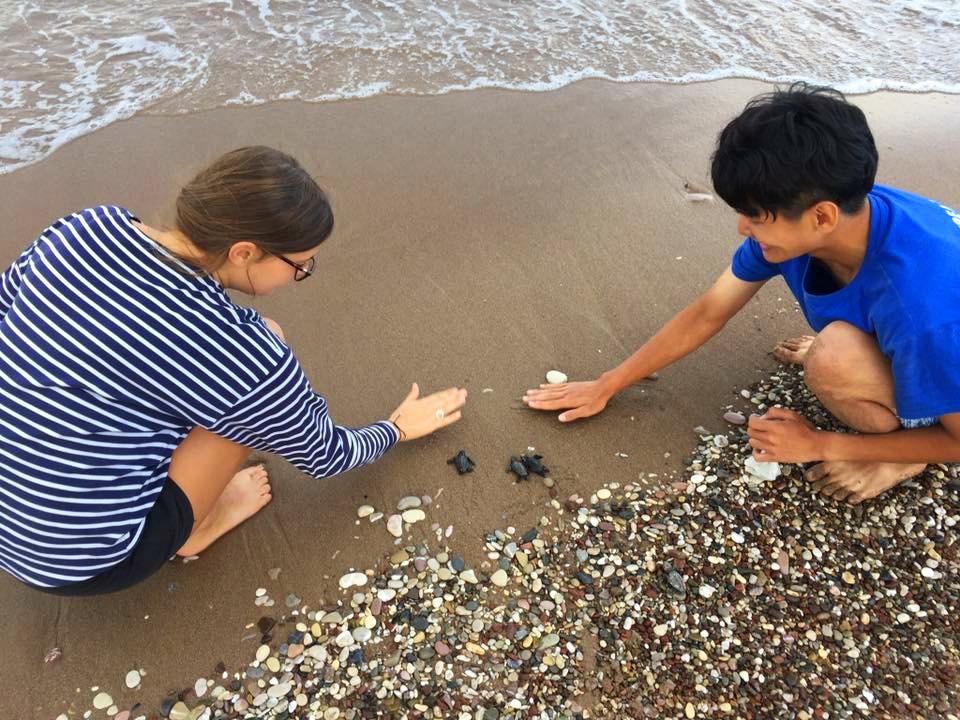
During the month I was there, about six injured turtles arrived. We gather necessary supplies and go pick them up, perform emergency first aid if needed, bring them back to rest (and give IV fluids if necessary), and the next day or the day after we remove barnacles attached to their shells, check wounds, measure length and weight, and record it.
The names of the newly arrived turtles are decided by volunteers through discussion. hahaha If you want a particular name, you have to get each volunteer''s agreement.ThisThe name is given a Greek name and they even look up its meaning. The volunteers are cute too.
# Most memorable moments

Some very sick turtles can''t eat. So they are fed through a tube: you open their mouth, insert the tube deep, and feed them mashed fish through it. The turtles suffer. They also get IV fluids. For turtles that can''t eat like this, we also try every day to hand-feed them fish.If you just place it in front of their mouth they won''t eat, so we use the fish to slightly pry their mouth open to force them to chew.
We try every day, but it''s pretty much a 99.9999% failure rate. It takes a long time and since it almost always fails, many volunteers actually don''t do it... They just hold the food at the mouth briefly and leave, so gradually I ended up taking on most of it.
Anyway, even if it failed, I tried every day, and as time accumulated later they''d at least chew one bite, then gradually chew more—three bites—and when that happened I felt really good that day.Then one day, I was trying with a turtle named Idra, and the little one chewed and ate an entire fish.
It ate two, then three, and by the end it had eaten as many as eleven.Now, even without me putting food into its mouth first, it would open its mouth, come up and go "aang" to bite and eat—seeing that almost made me cry. I remember being so happy I ran around telling the volunteers.
"Today Idra ate all the fish!!!"
Once it started eating, tube feeding and IVs were no longer necessary, so we didn''t have to subject it to those painful procedures anymore, and I was so happy about that.
What I learned working at the zoo was that if animals eat well, they''ll survive. Idra has now switched to hand-feeding, and if it eats even better we''ll give food one by one, and then eventually it will feed itself... Somehow that day doesn''t feel far off. Even during hand-feeding now, it opens its mouth wide as soon as it sees fish. Seeing that tightly shut mouth chomping away makes me feel full—my baby.

The second most moving moment is sending a turtle back to the sea! Luckily I got to experience this three days before I returned to Korea!! Fully recovered turtles swim in the big tank to build up their flipper muscles, and among them was a turtle named Lea. From the moment I first arrived she was in good condition in the big tank. Early on, when I was walking around looking at each turtle, I wondered, "which sea puppy is that?"—that turtle was Lea.

She was resting on the bottom, saw me and came up being all cute (maybe I was biased), literally like a sea puppy. I''m writing this while watching the video of Lea saved on my phone; I miss her so much... That day we released Lea into the sea: we drove south, then from the beach took a boat far out and released her. On the drive she sat on my lap, and on the boat I and two other volunteers gave her the final send-off into the sea.
Lea swam at top speed the moment she hit the sea. We were happy to see her healthy and silently wished that she''d no longer be injured or sick and would do well. Later I watched the video of me releasing her and cried. Our Lea... Are you doing well? I miss the turtles so much.
The saddest experience

The saddest experience is, of course, the death of turtles. Most of the turtles that die are those with cracked skulls. They all have the same head fractures because fishermen struck their heads with hammers, causing identical wounds... The sickest turtles just float motionless at the surface. Those are the ones with cracked skulls.
ThatDespite that, there was a turtle we thought was gradually improving. Very slowly it would move and swim at the surface, or when we tried hand-feeding it would manage up to three bites... It gained a bit of liveliness, and volunteers often said Aki seemed to be getting better, but then it suddenly died... That was the saddest moment.
Watch "Rescue Operation for Injured Turtles in Greece, Mediterranean — Part 2" (click)
The names of the newly arrived turtles are decided by volunteers through discussion. hahaha If you want a particular name, you have to get each volunteer''s agreement.ThisThe name is given a Greek name and they even look up its meaning. The volunteers are cute too. -Greece: Rescue operation for injured turtles in the Mediterranean/Lee Ji-yoon, gap-year member/gapper/ 4 weeks of gap year |
# Daily life on site
The first things you learn at the center are how to bathe turtles and how to clean the water tanks. Turtles usually weigh around 30–40 kg, and very heavy ones can weigh about 60 kg. The former are carried by two people, and the latter sometimes by three.
Cover wounds on the eyes and head with gauze, brush the face and even the claws on the flippers separately with a toothbrush, and wash the rest—the shell—with a sponge: gently but firmly, multiple times, and then,it becomes a pretty, clean brown, and it feels so refreshing. It''s become a bit of an occupational habit now —When I see photos or videos of wild turtles, I notice algae and grime and want to bathe them.
After bathing and rinsing them, turtles that need treatment go into treatment, and those that don''t are covered with a wet turtle towel while the tank is cleaned. You go inside and scrub everything hard with a brush to remove feces and algae, and collect the soapy water separately with a bucket and scoop to dispose of in the sink at the back.
More than anything else, I found activities like bailing water with a bucket and carrying it the hardest. At 3 PM the staff checks the temperature, and if the water is judged too hot, they empty about half the water with buckets and pour it into the hole leading to the sea to dispose of it—this is truly backbreaking and wears out your arms. During the few days when the pump was broken, we emptied and refilled everything with buckets and everyone was exhausted.You need a lot of physical stamina in many ways.
If there''s a hole inside the tank, you also have to powerfully wash out dirt from inside the hole, and check whether the hole is centered before refilling the tank,There are also many small tasks that require a bit of attention to detail.
After learning various things at first, you start learning treatments, but you can only actually do them after being taught by the local staff ''Pop'', so it''s good to push them a bit. haha Ask when you can learn injections or when you can start IV drips and you''ll learn faster.
Each turtle has different wounds, so you learn different treatments.Treatment is directly linked to the turtles'' lives, so you must know and follow every caution carefully. There are many little details.
There are also a few cats living at the center. It''s chaos whenever we''re cutting fish or preparing fish for tube feeding. We''ve all grown quite attached to them.
# The new turtles'' names are decided by volunteers through discussion.
During the month I was there, about six injured turtles arrived. We gather necessary supplies and go pick them up, perform emergency first aid if needed, bring them back to rest (and give IV fluids if necessary), and the next day or the day after we remove barnacles attached to their shells, check wounds, measure length and weight, and record it.
The names of the newly arrived turtles are decided by volunteers through discussion. hahaha If you want a particular name, you have to get each volunteer''s agreement.ThisThe name is given a Greek name and they even look up its meaning. The volunteers are cute too.
# Most memorable moments
Some very sick turtles can''t eat. So they are fed through a tube: you open their mouth, insert the tube deep, and feed them mashed fish through it. The turtles suffer. They also get IV fluids. For turtles that can''t eat like this, we also try every day to hand-feed them fish.If you just place it in front of their mouth they won''t eat, so we use the fish to slightly pry their mouth open to force them to chew.
We try every day, but it''s pretty much a 99.9999% failure rate. It takes a long time and since it almost always fails, many volunteers actually don''t do it... They just hold the food at the mouth briefly and leave, so gradually I ended up taking on most of it.
Anyway, even if it failed, I tried every day, and as time accumulated later they''d at least chew one bite, then gradually chew more—three bites—and when that happened I felt really good that day.Then one day, I was trying with a turtle named Idra, and the little one chewed and ate an entire fish.
It ate two, then three, and by the end it had eaten as many as eleven.Now, even without me putting food into its mouth first, it would open its mouth, come up and go "aang" to bite and eat—seeing that almost made me cry. I remember being so happy I ran around telling the volunteers.
"Today Idra ate all the fish!!!"
Once it started eating, tube feeding and IVs were no longer necessary, so we didn''t have to subject it to those painful procedures anymore, and I was so happy about that.
What I learned working at the zoo was that if animals eat well, they''ll survive. Idra has now switched to hand-feeding, and if it eats even better we''ll give food one by one, and then eventually it will feed itself... Somehow that day doesn''t feel far off. Even during hand-feeding now, it opens its mouth wide as soon as it sees fish. Seeing that tightly shut mouth chomping away makes me feel full—my baby.
The second most moving moment is sending a turtle back to the sea! Luckily I got to experience this three days before I returned to Korea!! Fully recovered turtles swim in the big tank to build up their flipper muscles, and among them was a turtle named Lea. From the moment I first arrived she was in good condition in the big tank. Early on, when I was walking around looking at each turtle, I wondered, "which sea puppy is that?"—that turtle was Lea.
She was resting on the bottom, saw me and came up being all cute (maybe I was biased), literally like a sea puppy. I''m writing this while watching the video of Lea saved on my phone; I miss her so much... That day we released Lea into the sea: we drove south, then from the beach took a boat far out and released her. On the drive she sat on my lap, and on the boat I and two other volunteers gave her the final send-off into the sea.
Lea swam at top speed the moment she hit the sea. We were happy to see her healthy and silently wished that she''d no longer be injured or sick and would do well. Later I watched the video of me releasing her and cried. Our Lea... Are you doing well? I miss the turtles so much.
The saddest experience
The saddest experience is, of course, the death of turtles. Most of the turtles that die are those with cracked skulls. They all have the same head fractures because fishermen struck their heads with hammers, causing identical wounds... The sickest turtles just float motionless at the surface. Those are the ones with cracked skulls.
ThatDespite that, there was a turtle we thought was gradually improving. Very slowly it would move and swim at the surface, or when we tried hand-feeding it would manage up to three bites... It gained a bit of liveliness, and volunteers often said Aki seemed to be getting better, but then it suddenly died... That was the saddest moment.
Watch "Rescue Operation for Injured Turtles in Greece, Mediterranean — Part 2" (click)
Capturing the growth journeys
of our participants.

 Home
Home


Take a step out of your comfort zone.
Challenge yourself for your own sake.
Feel complete freedom.
Be happy.