Projects
|
FAQ
|
Announcements



#Personal Growth #New experiences #Au Pair in South Korea
|
During a gap year in South Korea, a participant from Denmark lived with a Korean host family and helped care for their children through Korea GapYear’s Au Pair–Demi Pair Program. They read together almost every day, and when the children didn’t feel like reading, the participant made up stories in English using the pictures. Outside the home, one of the hardest adjustments was going to events without the friends they were used to having back in Denmark. |
I chose South Korea because I wanted to spend an extended period in a country whose history and language had fascinated me for a long time. Korea had been on my wish list for years, but I had never found the right opportunity to go. I did not want to experience the country only as a short-term visitor.
I wanted enough time to learn more about its culture and discover what everyday life was really like. While searching online for ways to stay in Korea during my gap year, I came across the Korea GapYear website. I looked through the different programs and found the Au Pair Program. It felt like the opportunity I had been waiting for: a way to come to Korea, live with a local family, and take part in something meaningful during my gap year.
I joined through Korea GapYear because having support made the idea of becoming an au pair in Korea feel more manageable. I had considered arranging an au pair experience independently, but doing everything alone felt uncertain.
Without an organization to help connect me with a host family and guide me through the process, there seemed to be many things I would have to handle by myself. For me, Korea GapYear became a bridge between my wish to live in Korea and the practical support I needed to make it happen. Knowing that I was not arranging the entire experience alone played an important role in my decision.
Back in Denmark, I have many younger cousins, so spending time with children was already familiar to me. That experience taught me that developing a relationship with children requires patience.
At first, I simply sat nearby and paid attention to what they were doing. I did not want to force myself into their play. Instead, I stayed close, offered help when they needed it, and allowed our relationship to develop naturally. Gradually, we became more comfortable with one another and began finding our own ways to communicate and spend time together.
Our everyday life included reading, storytelling, playing, and sharing plenty of unexpected moments together. We read a book almost every day. Sometimes, we sounded out the words together. When the children did not feel like reading, I used the pictures to create a short story in English and then asked whether they had understood it. It was a simple way to make reading more playful and interactive.
There was usually something funny happening, too. One day, the children tucked blankets under their pajamas while playing pretend. The boy did not seem entirely sure what the game was, so he filled his shirt with toy dinosaurs instead. It was one of those unexpected moments that made me laugh.
When it snowed, we also went outside and built a snowman together. We stayed outside for about an hour, enjoying the snow and spending time together. These ordinary moments became some of my favorite memories.
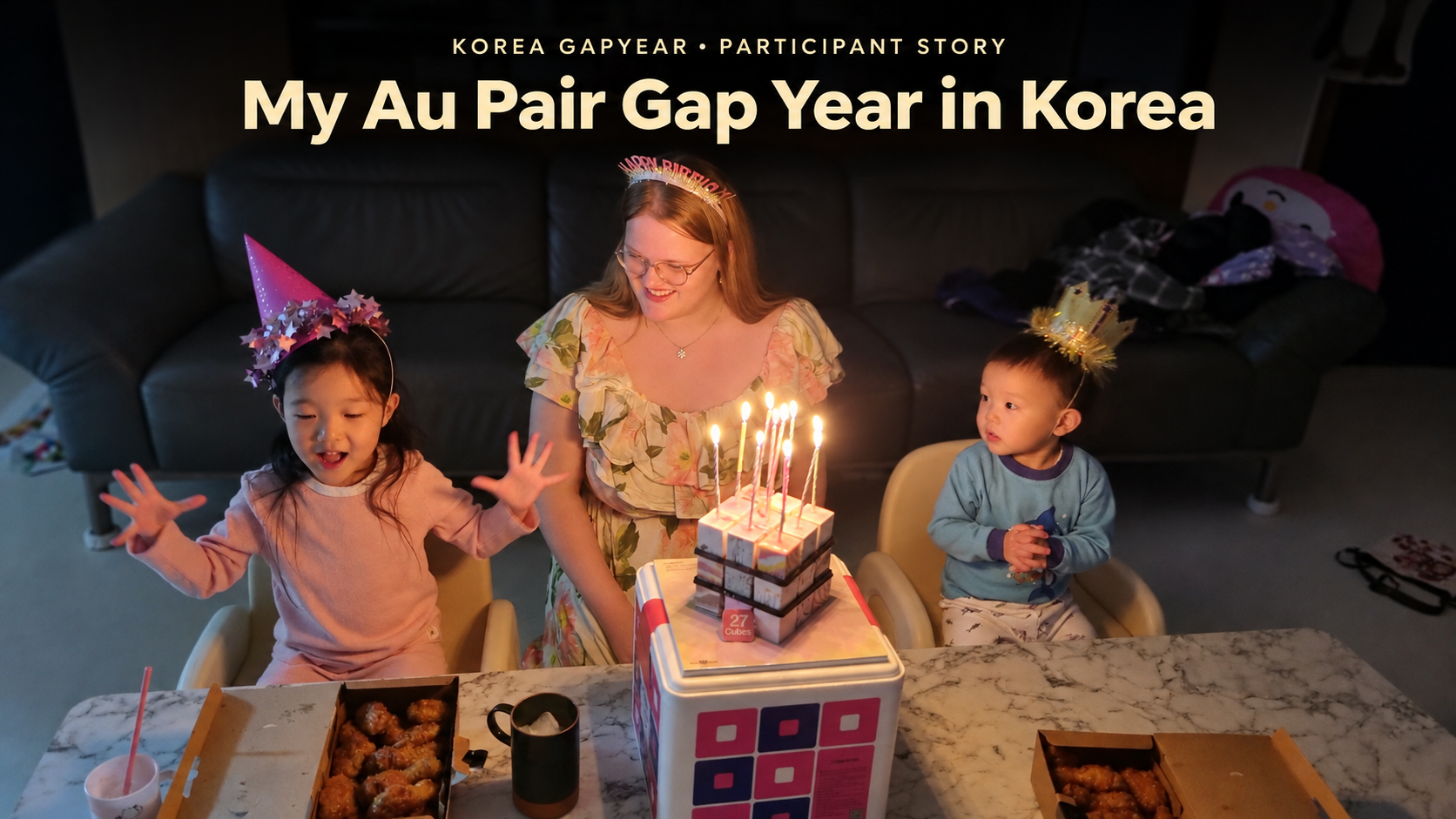
Celebrating special occasions and joining family gatherings made me feel included as another member of the family. On my birthday, my host family prepared my favorite Korean chicken and an ice cream cake. It was a thoughtful celebration that made me feel welcomed and remembered.
At Christmas, the whole family gathered together, and I even received a Christmas present, which I had not expected. I was also invited to travel with the family to a town near Busan to meet the grandparents. Sharing birthdays, holidays, and family visits allowed me to experience Korean family life in a way that would not have been possible as a short-term visitor.
I was not simply observing the culture from the outside. I was taking part in the family’s everyday routines and meaningful moments.
I learned that I could acknowledge what I found difficult and still choose to move forward. Starting again in a new country made me more aware of the situations that made me uncomfortable. It also encouraged me to be honest with myself and try things even when I did not feel completely confident.
For me, courage did not mean that I was no longer afraid or uncertain. It meant recognizing those feelings and deciding to take part in the experience anyway.
My advice is to remain open to new experiences and maintain a positive attitude when things do not go exactly as expected. A gap year can include exciting discoveries, but it can also involve loneliness, uncertainty, and moments when you have to step outside your comfort zone. It is important to be prepared for both.
Being alone or facing a difficult moment does not mean that there is nothing valuable in the experience. If you remain open and look for the positive parts, even an uncomfortable situation can become an opportunity to learn more about yourself. You do not have to feel completely ready before you begin. Sometimes, the most important thing is simply having the courage to try.
The Korea GapYear Au Pair–Demi Pair Program gives participants an opportunity to live with a Korean host family, provide childcare support, and experience Korean culture through everyday family life.
Rather than experiencing Korea only as a visitor, participants can build relationships with a local family, learn about daily customs, and develop practical skills such as communication, responsibility, and adaptability.

|
During a gap year in South Korea, a participant from Denmark lived with a Korean host family and helped care for their children through Korea GapYear’s Au Pair–Demi Pair Program. They read together almost every day, and when the children didn’t feel like reading, the participant made up stories in English using the pictures. Outside the home, one of the hardest adjustments was going to events without the friends they were used to having back in Denmark. |
I chose South Korea because I wanted to spend an extended period in a country whose history and language had fascinated me for a long time. Korea had been on my wish list for years, but I had never found the right opportunity to go. I did not want to experience the country only as a short-term visitor.
I wanted enough time to learn more about its culture and discover what everyday life was really like. While searching online for ways to stay in Korea during my gap year, I came across the Korea GapYear website. I looked through the different programs and found the Au Pair Program. It felt like the opportunity I had been waiting for: a way to come to Korea, live with a local family, and take part in something meaningful during my gap year.
I joined through Korea GapYear because having support made the idea of becoming an au pair in Korea feel more manageable. I had considered arranging an au pair experience independently, but doing everything alone felt uncertain.
Without an organization to help connect me with a host family and guide me through the process, there seemed to be many things I would have to handle by myself. For me, Korea GapYear became a bridge between my wish to live in Korea and the practical support I needed to make it happen. Knowing that I was not arranging the entire experience alone played an important role in my decision.
Back in Denmark, I have many younger cousins, so spending time with children was already familiar to me. That experience taught me that developing a relationship with children requires patience.
At first, I simply sat nearby and paid attention to what they were doing. I did not want to force myself into their play. Instead, I stayed close, offered help when they needed it, and allowed our relationship to develop naturally. Gradually, we became more comfortable with one another and began finding our own ways to communicate and spend time together.
Our everyday life included reading, storytelling, playing, and sharing plenty of unexpected moments together. We read a book almost every day. Sometimes, we sounded out the words together. When the children did not feel like reading, I used the pictures to create a short story in English and then asked whether they had understood it. It was a simple way to make reading more playful and interactive.
There was usually something funny happening, too. One day, the children tucked blankets under their pajamas while playing pretend. The boy did not seem entirely sure what the game was, so he filled his shirt with toy dinosaurs instead. It was one of those unexpected moments that made me laugh.
When it snowed, we also went outside and built a snowman together. We stayed outside for about an hour, enjoying the snow and spending time together. These ordinary moments became some of my favorite memories.
Celebrating special occasions and joining family gatherings made me feel included as another member of the family. On my birthday, my host family prepared my favorite Korean chicken and an ice cream cake. It was a thoughtful celebration that made me feel welcomed and remembered.
At Christmas, the whole family gathered together, and I even received a Christmas present, which I had not expected. I was also invited to travel with the family to a town near Busan to meet the grandparents. Sharing birthdays, holidays, and family visits allowed me to experience Korean family life in a way that would not have been possible as a short-term visitor.
I was not simply observing the culture from the outside. I was taking part in the family’s everyday routines and meaningful moments.
I learned that I could acknowledge what I found difficult and still choose to move forward. Starting again in a new country made me more aware of the situations that made me uncomfortable. It also encouraged me to be honest with myself and try things even when I did not feel completely confident.
For me, courage did not mean that I was no longer afraid or uncertain. It meant recognizing those feelings and deciding to take part in the experience anyway.
My advice is to remain open to new experiences and maintain a positive attitude when things do not go exactly as expected. A gap year can include exciting discoveries, but it can also involve loneliness, uncertainty, and moments when you have to step outside your comfort zone. It is important to be prepared for both.
Being alone or facing a difficult moment does not mean that there is nothing valuable in the experience. If you remain open and look for the positive parts, even an uncomfortable situation can become an opportunity to learn more about yourself. You do not have to feel completely ready before you begin. Sometimes, the most important thing is simply having the courage to try.
The Korea GapYear Au Pair–Demi Pair Program gives participants an opportunity to live with a Korean host family, provide childcare support, and experience Korean culture through everyday family life.
Rather than experiencing Korea only as a visitor, participants can build relationships with a local family, learn about daily customs, and develop practical skills such as communication, responsibility, and adaptability.
Capturing the growth journeys
of our participants.

 Home


Take a step out of your comfort zone.
Challenge yourself for your own sake.
Feel complete freedom.
Be happy.


