Projects
|
FAQ
|
Announcements





Capturing the growth journeys
of our participants.

Project Introduction
This program is an educational program where you can learn the violin-making process in an Italian city.
The violin is one of the best-known instruments in the Western orchestra. Around 1550, instruments similar to the violin were made in Italy, and over time the playing techniques and forms used to produce tone evolved into the modern violin.
The manufacturing process for producing the violin's excellent sound includes drawing the violin's basic shape,
selecting the woods to make the violin, and painting colors to achieve a beautiful finish — all stages require meticulousness and delicacy. The violin produced through all of these processes offers a beautiful sound to our ears.
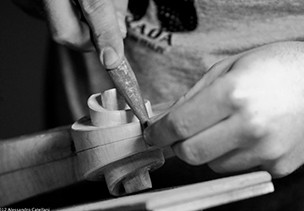
Through this program, participants can learn how to draw the basic shape of the violin needed for construction, develop an eye for distinguishing woods that are important for producing a beautiful sound, and learn step by step the basics such as how to choose wood. In addition, the process of applying color to the violin can also change its sound.
This is a program where you can learn all aspects of the manufacturing process, including hand-painting the violin's finish yourself.


About the Area


The area where this program takes place is a small town with a population of about 170,000, located just over an hour from Milan.It is also the place where Parmesan cheese, commonly sprinkled on pizza and pasta, is produced. Parma is a musical city that has produced composers and conductors related to Italian music. It also serves as a transportation hub connecting Milan and Bologna. Although it is a regional area, it is conveniently located for reaching major cities, making it an attractive base for traveling to other parts of Italy.
About the Institution


The school where this program is held is a violin-making school established in 1926.In 1933, it also established a location in Cremona, a city known for instrument making. The school teaches foundational knowledge and the overall practical techniques of violin making.The violins made by the violin maker, who has been teaching students since 2002, are played by many violinists in Italy and abroad.

Project activities
1. This programis conductedin Italian.
English requirement★★★☆☆
The main activities involve learning violin-making techniques. Since you will learn from Italian artisans, you can participate in the program if you can communicate at a basic level in Italian.
2.This program is a professional course for learning violin making.
3. This program is a two-year course, and the course begins in mid-October.
(From October to June each year, totaling 1,200 hours)
4. During the program period, you will learn to make violins or cellos.
* The school provides all materials and tools needed for instrument making during the school's workshop hours.
Class schedule
Classes are held five days a week, Monday to Friday,and you will attend classes for 7 hours a day.
|
9:30 AM ~ 1:00 PM |
Workshop sessions |
|
1:00 PM ~ 2:00 PM |
Lunch break |
|
14:00 ~ 17:30 |
Workshop session |

Violin making process
1. Drawing the violin body plans and machining
2. Measuring and making the violin body's top and back plates
3. Making the F-holes of the violin body
4. Measuring and making the ribs
5. Fitting and machining the ribs
6. Fitting and assembling the top plate, back plate, and ribs
7. Cutting and inlaying the purfling
8. Making and machining the scroll and neck
9. Measuring and fitting the fingerboard
10. Joining the body and neck, and finishing the scroll
11. Body sanding and drying
12. First hand varnish application and drying
13. Second hand varnish application and natural drying
14. Natural drying and maturation after multiple varnish applications
15. Final inspection and completion

* The most fundamental process in violin making is drawing the plans for the violin body.
This is the most basic work and the initial process for those learning instrument making and taking violin-making training. Based on the drawn plans, you will learn how to measure and make the violin's top (front) and back plates. Also, the most important factor in producing a resonant yet clear violin tone is the wood used for the instrument.
You will learn how to select wood for violin making and how to dry the wood. Using a dried violin mold as a reference, you will learn to apply color, varnish the violin, and allow the violin to dry naturally.


How to apply for the project
1.Apply via the website
After completing the application on the website, submit the participation form.
▼▼▼▼▼
2.Fill out the application form
Participation application form on the website/Write and submit a resume
▼▼▼▼▼
3.Pay the participation fee
Deposit the program participation fee to carry out the program with the local organization.
(After paying the participation fee,If the local organization refuses participation, the participation fee will be refunded100%will be refunded)
▼▼▼▼▼
4. Participation confirmed: 5~7days
About 5~7 days are required for confirmation.
(After participation is confirmed, the person in charge will contact participants individually by phone)
▼▼▼▼▼
5. Online Orientation
After confirmation, a briefing on preparations and the program, other paperwork will be handled
(Detailed information about the orientation will be provided via email.)
▼▼▼▼▼
6. Departure(overseas)
Participants will depart individually according to their schedules, 'Milan Malpensa International Airport' arrive at.
▼▼▼▼▼
7. Local orientation
The local staff will inform participants about the activity details, and provide an overall briefing on the program, including precautions,
adapting to local life, such as accommodation and meals, conduct a local orientation regarding safety issues, etc.
▼▼▼▼▼
8. Program start
Participants will begin the program on the dates they requested when applying.
Program dates and length of stay are unrelated. When the program has ended, Independent travel locally is possible
* Please book flight tickets and transportation after you receive final confirmation of project participation and the departure schedule.

Eligibility
- Physically healthy adults aged 18 and over
- Those interested in violins or instrument making
- Those who want to learn violin-making techniques from master luthiers
- Those who want to live alongside violin makers
- Those who want to experience living in an Italian city
- Those with an open mind
Schedule and Fees
|
The participation period for this program isAt least one year(Semester-based) The project feeat the top of this pageYou can easily check the detailed amounts for each duration and option. |
|||
|
* For popular projects, there may be no available positions (TO).Please apply quickly to secure a spot.
If you have difficulty paying in full,Prepay a 500,000 KRW registration feeand if you pay the remaining balance within 2 weeks, the date you paid the registration fee will be used as the reference.A confirmation process for project participation will be conducted to verify whether you can participate and to confirm available slots (TO). To join on your desired date and period, securing a spot quickly is important!(Non-refundable once participation is confirmed) *However, if the start date is imminent, the schedule for paying the remaining balance may change depending on the circumstances. ■Early bird discount andUrgent applicationInformation Due to standard processing procedures and the gap year preparation period for all gap year projects,it is recommended to apply at least 3 months before the project start dateand,As a rule, applications should be submitted no later than two months in advance.This is the principle. However, if there are unavoidable reasons or you urgently need to join a project, you can pay an additional fee through the urgent application service and we will assist with the fastest possible processing procedures. *We assist with the fastest possible processing, but basic time is required for communication with local organizations and for confirming participation, and because all procedures are carried out the same as for regular participants, participants applying through the urgent application service must actively cooperate with the Korea Gap Year operations teamYou must do so. **Participants who apply at least 180 days before the start date can receive an early-bird discount. ***The urgent application service can be selected from the options above. For inquiries about the urgent application service, please contact koreagapyear@gmail.com.
**Note: For ultra-urgent applications, there may be no available slots depending on local circumstances, and subsequent procedures will proceed according to Gap Year refund policies.Also,Any issues resulting from a participant's lack of cooperation are the responsibility of the participant. |
|||
|
Included items |
|||
|
- Local program operation and training costs
- Local orientation costs
- Korea Gap Year overseas experience certificate
- Participation fee
|
- Registration and placement, training, and project execution costs
- Program registration fee - Participant dispatch processing costs - Online orientation fee |
||
|
Not included |
|||
|
-Round-trip airfare |
|||
* Please book flights and transportation after your project participation is confirmed and you have received the final departure schedule.
Accommodation information

Participants can freely choose accommodation in the program area according to their preferences and budget.
If participants have difficulty finding accommodation,Korea Gap Year willrecommend accommodations (guesthouses/hotels, etc.) near the project location.
* Accommodation type information
1. Homestay
International students stay with a local host family in the country where they study, learning the country's culture and language. They live with the family, developing language skills through daily communication and gaining understanding of local lifestyles, values, and cultural practices.
2. Guesthouse
Guesthouses feature shared kitchens, bathrooms, and showers. Rooms are often arranged as 4-person or 6–8-person dormitories, with several people sharing a single room. When traveling briefly to another country, people often stay in guesthouses to meet other travelers, exchange stories, and share travel tips.
3. Apartment share
An apartment share is when about 5–6 international students rent a house together and live communally. Depending on the accommodation, you can choose a private room or share a room with one roommate. Unlike a homestay, it is not a family setting; residents share household chores such as meals, cleaning, and laundry with friends. It offers the advantage of living with people from various countries.
Travel Information
Region:Parma, Italy

Top Destination 1 - Milan Duomo Cathedral
The Duomo, whose name implies a domed roof, is a cathedral featuring a vaulted ceiling. In Italy, a duomo is the cathedral where the priest officiates mass, and many cities have their own duomo. Historically, architects would build the duomo at the center of a city and then develop squares, public facilities, and shops around it to form the urban center. Milan's Duomo is vast and imposing in scale. Visit Milan's iconic Duomo Cathedral to feel its grandeur firsthand.

Top Destination 2 - Bologna
When people think of food in our country, many dishes come to mind! Bologna is famous as Italy's culinary city. Familiar pastas such as pomodoro, aglio e olio, and carbonara include Bolognese spaghetti, which originates from the Bologna region. Many tourists visit the city to taste Bologna's special spaghetti made with tomato sauce and minced meat. In addition to spaghetti, there are many rich and tasty dishes, and the city is even nicknamed 'the city of the fat people.'

Top Destination 3 - Cremona
Cremona, Italy, is the city where the master violin maker Antonio Stradivari lived and produced violins throughout his life. The Amati family, Guarneri, and other top maestros in the history of string instruments crafted exquisite violins there. To this day, his descendants and many apprentices who want to learn violin making visit the city. As a world-renowned center for string instrument making, it is a small city with many violin workshops, and you can hear the sound of violins on the streets—truly a city of music.
Estimated Cost
(Based on 1 week)
| Item | Details and Remarks | Amount | Category |
| Round-trip airfare (including tax) | Varies by flight | Estimated KRW 500,000–1,300,000 | Exclusions |
| Visa issuance fee | Visa-free entry for up to 90 days (3 months) | - | |
| Individual travel insurance fee | Varies by insurer and duration | Estimated KRW 35,000 | |
| Local living expenses | Meals (breakfast/lunch/dinner) during the stay | Estimated KRW 40,000 | |
| Airport fee | - | - |
*Airfare may vary depending on the flight.
*Local living expenses are based on average estimates and may vary depending on participants' preferences..
*Participant's travel expenses and personal pocket money are separate.
•Note (Estimated local prices)
|
Accommodation |
Per night |
Meal |
Per meal |
|
Guesthouse |
Approx.30,000KRW (estimated) |
Local meal |
Approx. 7,000KRW (estimated) |
|
Hotel |
Approx.100,000KRW (estimated) |
Restaurant |
Approx. 20,000KRW (estimated) |
*Estimated local prices are based on average standards and may vary depending on participants' preferences.
Important Notes
1. This program 3-4 months it is recommended to apply with approximately that much lead time..
2. Except for the program activity period, a validity of 6 months or more on the passport is required.
3. Refunds due to participants' personal circumstances are not possible after the program is confirmed.
4. By applying for the project, participants are considered to have agreed to the Gap Year refund policy.
5. This project
6. The project schedule and content are subject to local circumstances(transportation,weather changes, etc.)or may vary depending on the circumstances of local organizations, and in unavoidable cases may be reduced or modified.
7. This project is operated by project implementing organizations that have partnered with Korea Gap Year. Therefore, responsibility for the actual operation lies with the local project organization.
8. For overseas travel safety information, the travel alert levels operated by the Ministry of Foreign Affairs are Travel Caution / Refrain from travel / Evacuation recommended / Travel prohibited 4 are divided into levels, and the Ministry of Foreign Affairs 'Overseas Safe Travel' site ( www.0404.go.kr) Detailed information can be found at.
9. Please book airline tickets and transportation only after your project participation is confirmed and your departure schedule is finalized. We provide individual guidance on the schedule after confirmation.
■Visa information
Italy can be visited without a visa. Tourist stays are permitted for up to 90 days per visit.
Some inclusions are available when options are added or selected.



 Home
Home

Take a step out of your comfort zone.
Challenge yourself for your own sake.
Feel complete freedom.
Be happy.



Capturing the growth journeys
of our participants.