Projects
|
FAQ
|
Announcements



#Increased independence, a more positive attitude #Problem-solving skills, new goals #An experience that allowed me to see many things

I wanted to steady my mind a bit and come back feeling free. It was also the first time I would go abroad alone. I thought that after going I''d be able to overcome not only career-related issues but also other personal difficulties I''d experienced. I needed to be courageous.
-Olla! Bucket List Top Chart — Introduction to Spanish / Lee So-won, gap-year participant / 4-week gap year |
Q. Please give a brief introduction~
I took a year off from school and kept working at a café.
My major was business administration, but I was very interested in coffee, so I studied for certifications and started working at a café. However, it wasn''t easy. The deeper I went, the broader it became, and the place I worked had limits for learning professionally, so I quit.
After that, I was wondering what I should do.
Q.Why did you take time off?
There wasn''t any particular reason; I just didn''t want to keep attending school. SoAt first I got the certification without much thought,Then I wondered what to try next, and because I liked coffee I decided to study it and started working at a café—that''s how I started.
Q. How did you find out about gap years?
Ms. Son Mina''s ''''Spain, You Are Freedom''I happened to read the book,Spainand I began to want to go there.
From then on I kept looking into ways to go to Spain and came across Korea Gap Year.And wanting to achieve both goals,I joined this program where I could live in Spain and also learn Spanish.

Q. When you left for Spain for your gap year, what was the status of your dream to become a barista?
I had almost given up on it.
I wanted to collect my thoughts a bitfreedomI wanted to go and feel it and come back.And it was the first time I''d be going abroad alone. So I thought that after going I''d be able to overcome not only career problems but also other personal difficulties I''d been facing.
CourageI needed to have courage.
I thought a lot and only had the desire to go to Spain, but I hurriedly went through with it to force myself to be brave.I thought a lot and went because I wanted to grow more.
Q. How did you prepare?
I went with almost no preparation. I packed my bags the day before and went without researching anything.
Q. It was your first time taking on such a challenge — weren''t you worried?
I was worried, but my mom worried even more and kept telling me not to go. She usually has high expectations of me and gets very involved.So I think I pushed through quickly because I wanted to show that I could do it (laughs).

Q. How did you feel when you first arrived in Spain?
I had arranged a pickup in advance and left, so I waited at the airport without much worry. But the pickup didn''t show up.
I contacted Korea Gap Year, but the Wi‑Fi cut out before I got a reply.With no choice, I waited aimlessly at the airport until I met the driver and got into the car, but I was so annoyed that I just stayed quiet.But the driver was such a nice person. He played music and kept talking to cheer me up, so my worries about life in unfamiliar Spain eased.
Later I found out he was late because he had a minor accident on his way.
Q. Regarding the Spanish language school''s classesHow were the structure and organization?
The school was really good.They say it varies by teacher, but our class''s teacher was really great. When people say teachers are different, it''s not that some are bad at teaching—it''s more that some teachers just don''t suit certain students.
We started with 3 students at first, and since classes start every Monday, more people joined so on average about 7 of us studied together.
Above all, the best part is that the teachers are friendly, and you can experience a different teaching method than the conversation classes I''ve taken so far.
For example, you can really ask questions freely. I usually don''t ask many questions in class, but there they kindly explain things you don''t know until you understand, so I kept asking.
I went knowing not a word of Spanish, so at first I couldn''t understand what was being said and was dazed, but because the classes were small they explained things well until I understood.
Also, every Wednesday is a day for the students at the academy to meet.At that time one teacher attends with them, and you can freely chat and hang out while drinking alcohol or coffee.They usually have parties on Fridays. I once participated in a party, and...After partying until 5 a.m. on Saturday, I slept the whole Saturday, and on Sunday I only went briefly to nearby places; after that I didn''t join parties and instead traveled to farther places on the weekends.
Q. Could you tell me about a typical day?
Classes were from 9 to 12, and my accommodation was two minutes from the school (laugh). I would get up, wash, and leisurely go to school.
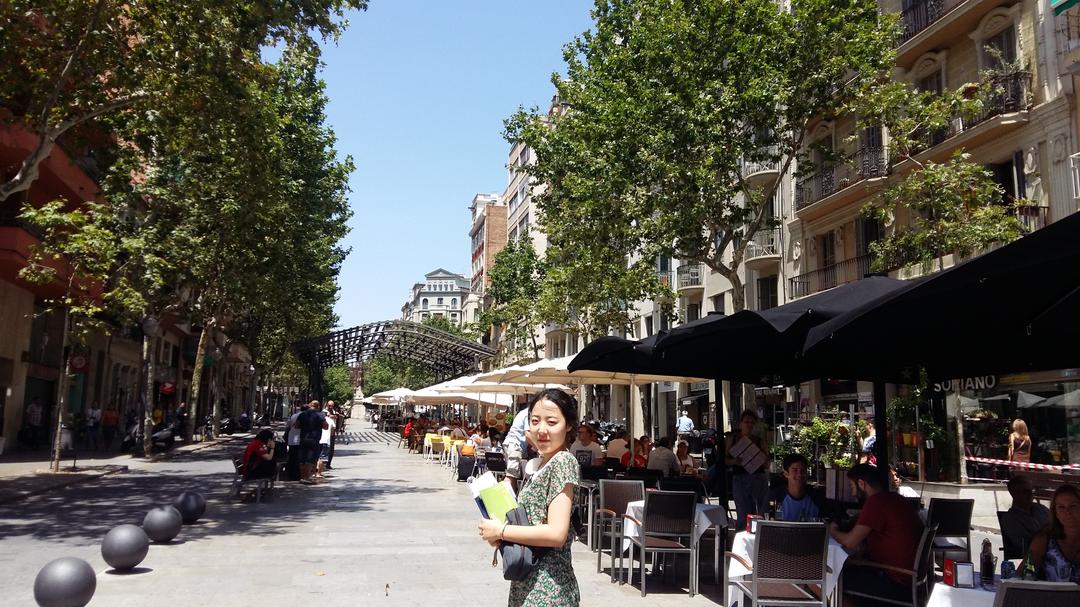
When classes finished at 12, from then on it was free time.So I kept going out to eat. I went to places that were said to be good and ate, and visited places that sounded nice to look around.By the time I returned it was evening, so I had dinner at home.
I shared an apartment. I lived with a family and had my own room. But eating dinner with the family cost money, so to save money I usually bought ingredients at a cheap Korean grocery and mostly made pasta myself.

Q.What do you learn in class?
You learn in a progression similar to learning English. At first you learn the alphabet, and then''greetings'' and things like ''where are you from, hobbies, asking for directions, colors''.basic conversationwe learned.
Q.Were the classes difficult?
The first week was hard.I couldn''t understand anything, and the teacher deliberately didn''t use English.
Instead, they kindly kept explaining with drawings and gestures until we understood.Also, it helped that the European students in the class explained things in English, so after I adapted I surprisingly began to understand and see things little by little.
Q. If you went back to Spain now, what do you think it would be like?
I think I could travel without much trouble.
Because I learned things like numbers and menus, I can manage when using public transportation or choosing from a menu.
When I first went there I really only ate chicken. I didn''t know what the other items meant and couldn''t tell what would come, but even if it turned out badly, chicken is still chicken (laugh).
Q. What was the most difficult experience?
One weekend I went up to a monastery on a mountain. It would have been fine if we''d only gone to the monastery, but the problem was that we took a climbing train called a funicular and went further up. Shortly after going up, the funicular''s operating hours ended. Not knowing what to do, I met some French students who were also flustered like me and we decided to walk down together. But it had snowed on the mountain and the path was icy. In the end we came down slipping and falling over the course of two hours.
After coming down from the mountain, all the trains home had stopped running. After a long time looking for someone to ask for help, I approached a person who was leaving work and pulled out all the Spanish I had learned to ask them to help me get to my accommodation, and was able to return.
Q.What was the most fun or best memory?
ClassesTo start with,I liked the relaxed atmosphere.
It felt like studying together with friends?The teachers were approachable and taught in a relaxed way. And all the classmates were nice.
There were also classes where we learned through movement and activities, so we could learn happily rather than heavily, laughing as we went.
Daily lifeis about when encountering a problem—it''s the memory of trying to solve that problem.
John Maxwell''s <Attitude>I took a copy of that book and read it now and then, and it helped a lot.
As the book says, even if I got lost and walked around for 30–40 minutes, I didn''t give up and tried to find a solution,If you try, a solution will come.With that thought, I was able to stay cheerful.

Q. Please tell me about the people you met during your gap year.
I had my own room, but there were roommates in the same apartment: a French friend, a German friend, a Chinese friend, and me — four people in total.
We were friendly, but each of us lived quite individually; we''d do our own things, and if there was somewhere to go someone would ask, ''Want to go together?''so we''d go together. Also, there were a Korean friend and a Chinese friend in my class, so I was able to become closer to them quickly.
Q.When you compare before and after your gap year, have you noticed any changes?
I used to not be good at doing things by myself, but thanks to this gap year I''ve had to solve things independently more often.
Even now, when talking with friends they say they want to go to Europe but don''t have anyone to go with and don''t know what to do. People say good things are twice as good when seen together and food tastes better when eaten together, and I used to feel the same way.
When I was in Korea I never made food for myself. But in Spain, even though they were much younger, my European friends would make things with ease. So I also cooked sometimes and traveled alone and became a bit more independent.
And I changed in appearance.
I used to wear a lot of makeup. But when I went there and only did the basics, my skin got much better. So now I wear less. Also, without being rushed by anything, I really laughed a lot and was happy. Big cities like Barcelona aren''t like that, but when you go to smaller cities everyone is friendly and fun, soI came back feeling very energized.
Q.Have any new goals come up?
I don''t think I need to do coffee (laughs).I drank coffee every day in Spain.You don''t necessarily have to be a barista—anyone can make and drink coffee. Sorather than learning it professionally, I want to keep it as something I enjoy going forward.
I''ve come up with a lot of new goals.
First, I''m going to study world history.There''s so much I don''t know.And I decided to study Korean history as well.I was so ashamed that I couldn''t explain things because I didn''t know much about my own country.
I''ll keep studying Spanish too. I''m still consistently memorizing vocabulary. SoI want to go again, take a higher-level class this time, and travel to places I haven''t been.
Finally, I''ll return to school and study my major very hard.The path I was onI felt I should put more effort into it.

Q.What does a gap year mean to me?
"An experience that allowed me to see many things."
If I had just continued studying my major, I wouldn''t have known, but I learned something different—coffee—and took on the challenge of Spain. That allowed me to put aside wondering about the paths I hadn''t taken and concentrate on my own path.
I wanted to steady my mind a bit and come back feeling free. It was also the first time I would go abroad alone. I thought that after going I''d be able to overcome not only career-related issues but also other personal difficulties I''d experienced. I needed to be courageous.
-Olla! Bucket List Top Chart — Introduction to Spanish / Lee So-won, gap-year participant / 4-week gap year |
Q. Please give a brief introduction~
I took a year off from school and kept working at a café.
My major was business administration, but I was very interested in coffee, so I studied for certifications and started working at a café. However, it wasn''t easy. The deeper I went, the broader it became, and the place I worked had limits for learning professionally, so I quit.
After that, I was wondering what I should do.
Q.Why did you take time off?
There wasn''t any particular reason; I just didn''t want to keep attending school. SoAt first I got the certification without much thought,Then I wondered what to try next, and because I liked coffee I decided to study it and started working at a café—that''s how I started.
Q. How did you find out about gap years?
Ms. Son Mina''s ''''Spain, You Are Freedom''I happened to read the book,Spainand I began to want to go there.
From then on I kept looking into ways to go to Spain and came across Korea Gap Year.And wanting to achieve both goals,I joined this program where I could live in Spain and also learn Spanish.
Q. When you left for Spain for your gap year, what was the status of your dream to become a barista?
I had almost given up on it.
I wanted to collect my thoughts a bitfreedomI wanted to go and feel it and come back.And it was the first time I''d be going abroad alone. So I thought that after going I''d be able to overcome not only career problems but also other personal difficulties I''d been facing.
CourageI needed to have courage.
I thought a lot and only had the desire to go to Spain, but I hurriedly went through with it to force myself to be brave.I thought a lot and went because I wanted to grow more.
Q. How did you prepare?
I went with almost no preparation. I packed my bags the day before and went without researching anything.
Q. It was your first time taking on such a challenge — weren''t you worried?
I was worried, but my mom worried even more and kept telling me not to go. She usually has high expectations of me and gets very involved.So I think I pushed through quickly because I wanted to show that I could do it (laughs).
Q. How did you feel when you first arrived in Spain?
I had arranged a pickup in advance and left, so I waited at the airport without much worry. But the pickup didn''t show up.
I contacted Korea Gap Year, but the Wi‑Fi cut out before I got a reply.With no choice, I waited aimlessly at the airport until I met the driver and got into the car, but I was so annoyed that I just stayed quiet.But the driver was such a nice person. He played music and kept talking to cheer me up, so my worries about life in unfamiliar Spain eased.
Later I found out he was late because he had a minor accident on his way.
Q. Regarding the Spanish language school''s classesHow were the structure and organization?
The school was really good.They say it varies by teacher, but our class''s teacher was really great. When people say teachers are different, it''s not that some are bad at teaching—it''s more that some teachers just don''t suit certain students.
We started with 3 students at first, and since classes start every Monday, more people joined so on average about 7 of us studied together.
Above all, the best part is that the teachers are friendly, and you can experience a different teaching method than the conversation classes I''ve taken so far.
For example, you can really ask questions freely. I usually don''t ask many questions in class, but there they kindly explain things you don''t know until you understand, so I kept asking.
I went knowing not a word of Spanish, so at first I couldn''t understand what was being said and was dazed, but because the classes were small they explained things well until I understood.
Also, every Wednesday is a day for the students at the academy to meet.At that time one teacher attends with them, and you can freely chat and hang out while drinking alcohol or coffee.They usually have parties on Fridays. I once participated in a party, and...After partying until 5 a.m. on Saturday, I slept the whole Saturday, and on Sunday I only went briefly to nearby places; after that I didn''t join parties and instead traveled to farther places on the weekends.
Q. Could you tell me about a typical day?
Classes were from 9 to 12, and my accommodation was two minutes from the school (laugh). I would get up, wash, and leisurely go to school.
When classes finished at 12, from then on it was free time.So I kept going out to eat. I went to places that were said to be good and ate, and visited places that sounded nice to look around.By the time I returned it was evening, so I had dinner at home.
I shared an apartment. I lived with a family and had my own room. But eating dinner with the family cost money, so to save money I usually bought ingredients at a cheap Korean grocery and mostly made pasta myself.
Q.What do you learn in class?
You learn in a progression similar to learning English. At first you learn the alphabet, and then''greetings'' and things like ''where are you from, hobbies, asking for directions, colors''.basic conversationwe learned.
Q.Were the classes difficult?
The first week was hard.I couldn''t understand anything, and the teacher deliberately didn''t use English.
Instead, they kindly kept explaining with drawings and gestures until we understood.Also, it helped that the European students in the class explained things in English, so after I adapted I surprisingly began to understand and see things little by little.
Q. If you went back to Spain now, what do you think it would be like?
I think I could travel without much trouble.
Because I learned things like numbers and menus, I can manage when using public transportation or choosing from a menu.
When I first went there I really only ate chicken. I didn''t know what the other items meant and couldn''t tell what would come, but even if it turned out badly, chicken is still chicken (laugh).
Q. What was the most difficult experience?
One weekend I went up to a monastery on a mountain. It would have been fine if we''d only gone to the monastery, but the problem was that we took a climbing train called a funicular and went further up. Shortly after going up, the funicular''s operating hours ended. Not knowing what to do, I met some French students who were also flustered like me and we decided to walk down together. But it had snowed on the mountain and the path was icy. In the end we came down slipping and falling over the course of two hours.
After coming down from the mountain, all the trains home had stopped running. After a long time looking for someone to ask for help, I approached a person who was leaving work and pulled out all the Spanish I had learned to ask them to help me get to my accommodation, and was able to return.
Q.What was the most fun or best memory?
ClassesTo start with,I liked the relaxed atmosphere.
It felt like studying together with friends?The teachers were approachable and taught in a relaxed way. And all the classmates were nice.
There were also classes where we learned through movement and activities, so we could learn happily rather than heavily, laughing as we went.
Daily lifeis about when encountering a problem—it''s the memory of trying to solve that problem.
John Maxwell''s <Attitude>I took a copy of that book and read it now and then, and it helped a lot.
As the book says, even if I got lost and walked around for 30–40 minutes, I didn''t give up and tried to find a solution,If you try, a solution will come.With that thought, I was able to stay cheerful.
Q. Please tell me about the people you met during your gap year.
I had my own room, but there were roommates in the same apartment: a French friend, a German friend, a Chinese friend, and me — four people in total.
We were friendly, but each of us lived quite individually; we''d do our own things, and if there was somewhere to go someone would ask, ''Want to go together?''so we''d go together. Also, there were a Korean friend and a Chinese friend in my class, so I was able to become closer to them quickly.
Q.When you compare before and after your gap year, have you noticed any changes?
I used to not be good at doing things by myself, but thanks to this gap year I''ve had to solve things independently more often.
Even now, when talking with friends they say they want to go to Europe but don''t have anyone to go with and don''t know what to do. People say good things are twice as good when seen together and food tastes better when eaten together, and I used to feel the same way.
When I was in Korea I never made food for myself. But in Spain, even though they were much younger, my European friends would make things with ease. So I also cooked sometimes and traveled alone and became a bit more independent.
And I changed in appearance.
I used to wear a lot of makeup. But when I went there and only did the basics, my skin got much better. So now I wear less. Also, without being rushed by anything, I really laughed a lot and was happy. Big cities like Barcelona aren''t like that, but when you go to smaller cities everyone is friendly and fun, soI came back feeling very energized.
Q.Have any new goals come up?
I don''t think I need to do coffee (laughs).I drank coffee every day in Spain.You don''t necessarily have to be a barista—anyone can make and drink coffee. Sorather than learning it professionally, I want to keep it as something I enjoy going forward.
I''ve come up with a lot of new goals.
First, I''m going to study world history.There''s so much I don''t know.And I decided to study Korean history as well.I was so ashamed that I couldn''t explain things because I didn''t know much about my own country.
I''ll keep studying Spanish too. I''m still consistently memorizing vocabulary. SoI want to go again, take a higher-level class this time, and travel to places I haven''t been.
Finally, I''ll return to school and study my major very hard.The path I was onI felt I should put more effort into it.
Q.What does a gap year mean to me?
"An experience that allowed me to see many things."
If I had just continued studying my major, I wouldn''t have known, but I learned something different—coffee—and took on the challenge of Spain. That allowed me to put aside wondering about the paths I hadn''t taken and concentrate on my own path.
Capturing the growth journeys
of our participants.

 Home
Home


Take a step out of your comfort zone.
Challenge yourself for your own sake.
Feel complete freedom.
Be happy.