Projects
|
FAQ
|
Announcements



#Moved from uncertainty to confidence in my career path #Checked myself and put my mindset in order #Started casually and learned responsibility
.jpg "yeoungeun_cam (1).jpg")
An opportunity to recheck my mentality. To put it metaphorically, I didn''t realize until now that my mentality was rotten and I had the fixed idea that I was on the right path, but I began to think more about myself... Previously I worried I might be vaguely thinking about overseas volunteering itself, but I think I became more certain about myself in a more concrete way. It became a chance to decide my career path and an opportunity to check myself.
-Cambodia English teaching volunteer work that plants the seeds of learning in children |
Q.You haven''t been here long. I''m curious what you''ve been up to lately.
A. I did it in September last year, so it''s been about six months since I took a leave of absence. I originally took a leave to go on an overseas volunteer trip.These days I''m thinking of earning some more money and going abroad once more before returning to school. I want to go to Africa. I''m not sure (laughs).
Q.I heard you went to the Philippines before participating in this volunteer program.
A. Yes, last January I went for about a week with friends through a fair-travel agency.They call it voluntourism...(Do you mean combining travel and volunteering?)Yes, but we hardly did any volunteering. It was mostly travel, and while traveling I found myself feeling oddly unsettled.
Q.You went on the volunteer trip for about a month. Before you went, did your parents or people around you worry?
A. At first I thought about six months, but that didn''t align with my parents'' opinion. ''Do you think you can last six months? Just go for a month first.'' They reluctantly let me go (laughs).(Did you have your own way of persuading your parents?)After returning from the Philippines, I thought, ''Ah, I''ll take a leave starting next semester.'' From then on I kept telling myself, ''I''ll go on an overseas volunteer trip,'' ''I''m going to go. I must go.'' I basically brainwashed myself: I''m going, it''s my destiny...
My parents were like, ''What leave of absence? You only have one semester left. Earn some money and go later.''I said there''s no ''later.'' You should go while you''re young. If you go when you''re older your body will suffer. My parents asked why I had to go, so...I sat down and did a not-quite-PT presentation to explain. I printed out all the materials... If I just said I was going on a whim they''d worry, so I had to earn their trust. I had to prove there were reasons for postponing, so I showed them (laughs).
Q.There were several volunteer programs — was there a reason you chose this one?
A. At first I chose Thailand, but there were no openings so my participation was not approved. Then the coordinator called me directly, explained things, and recommended Cambodia. It was an English-education program, and since I''m not good at English I hesitated, but thought, ''Ah, it''ll work out somehow,'' applied, prepared hastily, and got contacted in December so I went.
Q.You actually taught English. You were worried before going — I''m curious if you had any difficulties.
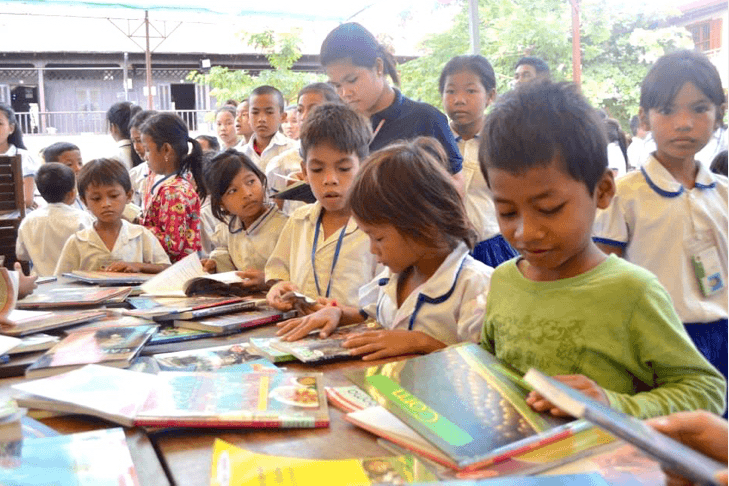
A. There were actually a lot of volunteers (about 20, mostly French), and everyone spoke English much better than I did. We mostly taught preschoolers, around five-year-olds, starting from the ABCs, and did tasks like seeking sponsorships.
Q.Was there a difference between the volunteer work you imagined before going and what you actually did on site?
A. It was a bit different. On the first day, I arrived and all I was told was that we had to get up at 7 a.m., and nobody showed up. The next day...the organization director came and said they wanted to receive sponsorship from companies in Korea and asked us to help. I hadn''t come to find sponsors... but I was put in charge of the project and carried it out. In the end we couldn''t complete the mission (contacting companies and securing sponsorship) and just returned. They had given us a project to contact companies to get regular sponsorship, but Korea isn''t in a mood to give sponsorships so readily, you know.(It seems like it must have been a difficult project)I sent emails to about 70 places but got rejected by all of them. And I couldn''t really call them from there. I regretted that if I had checked in advance I might have found even one place.
QQ. What was the size of the institution like?
A. The building was about three to four stories. There was a separate school building, offices, sleeping areas for the boys, and two or three places where the volunteers slept. The institution was pretty large, so it was a bit puzzling that they said they had no money.At one point we were robbed. About 100,000 won worth of money and a watch were stolen. They couldn''t find the watch, but they gave me the money back there.
After mine disappeared, other volunteers'' cameras went missing twice; a DSLR was lost and later found, but a compact digital camera couldn''t be found.The kids said they saw someone selling the watch. Actually I heard a rumor about a suspect who stole the watch, but I didn''t want to accuse a child, so I pretended not to know. I didn''t want to make a bigger deal out of it.(Which child are you referring to?)A child who lived there. Not a child attending classes, but one who lived there, eating and sleeping there. They gave me the money back... it made me think a lot.
Q.How long did it take to adapt to the local environment?
A. I tried to adapt quickly, but it seemed to take a while. About a week? A little over a week?(Was the food okay?)I eat well in general (laughs). The volunteers got fruit with every meal and there was always meat — the food was really good. The babies, however, seemed to get served in a more meager way and I often felt that it was poor. I felt guilty eating because the space was open and everyone could see each other. When the kids came and watched, I felt even more guilty while eating. The institution''s atmosphere was such that after morning duties they''d go out and play in the afternoon — they didn''t really stay at the institution, they''d just go out and have fun.
Q.So on weekdays you mainly taught in the mornings — what activities did you do in the afternoons?
A. In the afternoons we focused on project work, and in the evenings we bathed the children... Each day, two or three volunteers were assigned to bathe the kids, do laundry, and such. When bathing them, we''d have to catch the kids who ran away pretending they wouldn''t wash (laughs).(Were the children mainly orphans?)It was about a 60:40 split — by Friday, around 40% (4 out of 10) of the children went home for the weekend, and about 60% (6 out of 10) stayed at the institution.
Q.How were the accommodations locally?
A. The accommodations were better than I expected. I had been imagining very poor conditions. When I volunteered in the Philippines, I stayed in a wooden house with ants crawling everywhere, no electricity, and bad sheets... I thought it would be like that, but there was a separate bathroom and the lodging was fine (laughs).
Q.I''m curious how you got along with the children at the institution.
A. I taught about six or seven kids. But they were completely unruly five- and six-year-olds — running around, clinging, running away when told not to (laughs). You really can''t hit them.(Did you design the curriculum yourself?)We followed an existing curriculum. My main role was as an assistant, controlling the children.(It must have been hard when saying goodbye.)On the last day... I couldn''t stop crying. Two weeks before the end I felt like I was finally free, but when the last day actually came, I felt strange. I wished I could have stayed another month... I could only think of things I hadn''t done.... I cried a lot on the last day. We played music and had a party dancing to Korean songs like ''Gangnam Style.''
Q.Who was the most memorable person while volunteering?
A. A volunteer teacher. She was a 32-year-old female teacher; when I first arrived I couldn''t speak well and didn''t fit in, but she took care of me, gave me even a little extra, and I was really grateful. At the end she even came to the airport to see me off—she felt very motherly.(Was she an organization staff member?)No, she was also a volunteer from France and said she would be leaving after about three months. Everyone was really nice.(Did you go out together?)I was busy hanging out every Friday, Saturday, and Sunday (laughs).
Q.What were the nationalities and ages of the other volunteers like?
A. Mostly French people. French and Belgian... they were all Europeans, so I was the only Asian. There were maybe two people my age, and most were around 30 to 40.(Did those volunteers mainly take charge of education as well?)Yes, there were teachers, nurses, and even someone studying social welfare like me.(Did you interact with those people much?)We went out together a lot (laughs). Still, when they were together they spoke French, and my English wasn''t very good, so I sometimes felt a kind of alienation.(Did you ever feel cultural differences?)In our country, if someone asks ''what do you want to do?'', people often refuse at first—saying ''it''s okay'' two or three times before agreeing. But with them, if you say no, that''s it—just no!
Q.Have you traveled much?
A. I think I mostly traveled around Phnom Penh.(What was the atmosphere in Cambodia like?)It felt more prosperous than I had expected. There were a lot of buildings. But that seems to be only around Phnom Penh. I once visited the Killing Fields by myself. Driving on unpaved roads and seeing those things, I felt a stark wealth gap.
Q.If you look at this program overall, what would you say are its strengths and weaknesses?
A. To be honest, I didn''t prepare much before going. I spent too much time partying in Korea, so I have some regrets. I felt the NGO was well-organized. And maybe because I had imagined very extreme situations before going, the facilities were really clean and good. But there were aspects like that they expected donations from volunteers, and there were so many volunteers that I sometimes felt like unnecessary labor. There was no one to manage the volunteers, so while it''s good that volunteers could act freely, the lack of a manager created some distance between staff and volunteers. There was substantial interaction among the volunteers themselves.
Q.What advice would you give to participants who will join this program in the future?
A. Be careful with your belongings, and it would be really good to bring plenty of English teaching materials. But I think it depends on how you adapt. It would be good if your speaking ability is at least somewhat capable. If you can converse without a dictionary, that would be great—I was clinging to a dictionary.(What kind of personality do you think suits this program?)It''s an atmosphere driven mostly by volunteers, so someone somewhat outgoing who can at least get along well and isn''t afraid to be a bit forward would fit well.
Q.It was a period of one month. Comparing before and after, the change I see in myself is
A. On the first day I went, I thought, ''How am I going to endure a month?'' I felt like I couldn''t make it. I felt like I needed to go back to Korea right away. There was no one to welcome me or introduce me. From the first day, loneliness washed over me. At first I thought, ''Is this right?''

I wrote in my diary every day. On the first day I wrote ''How will I endure this?'' but on the last day, looking back at that, I felt so sorry toward those people. Also, the book I read at that time helped a lot. At the orientation before going they recommended helpful books, and I took two of them with me.the book ''Twenty, Never Give Up''Reading it made me reflect in a way that wasn''t exactly deliberate self-reproach, but I ended up reflecting. Things like how people in their twenties nowadays live like teenagers—trying to coast along or chase credentials, still getting allowance from their parents. ''If you want to become someone important later, become someone who can earn money now; if you still receive allowance now, you''ll be living on allowance in your thirties''—that line really resonated with me. I thought I was an adult, but I had actually been living like a child. So I''m trying to get my mentality back in order (laughs).
Q.How does the gap year program differ from other volunteer programs?
A. If other programs are mainly about being led, the gap year program is more about taking initiative and doing things yourself. If you don''t plan it, it won''t happen. They said before going that there would be a lot of time alone. I wondered why there would be so much time when there would be programs, but when I actually went, I realized I had to plan things myself. It seems to revolve around ''me''—I plan it myself and I do it...
An opportunity to examine myself
Q.To Yeongeun, the gap year is
A. An opportunity to re-examine my mentality. To put it metaphorically, I didn''t realize my mentality was rotten until now and I had a fixed idea that I was on the right path, but I started thinking more about myself... Previously I worried that I might be thinking about overseas volunteering too vaguely, but I think I became more certain about myself in a more concrete way. It seems to have been an occasion to decide my career path and to check myself.
Q.What are your plans for the future?
A. Before returning to school in September, I plan to study more and get one more certification, and I''m thinking of going on another overseas volunteer trip for about one to two months (laughs).

An opportunity to recheck my mentality. To put it metaphorically, I didn''t realize until now that my mentality was rotten and I had the fixed idea that I was on the right path, but I began to think more about myself... Previously I worried I might be vaguely thinking about overseas volunteering itself, but I think I became more certain about myself in a more concrete way. It became a chance to decide my career path and an opportunity to check myself.
-Cambodia English teaching volunteer work that plants the seeds of learning in children |
Q.You haven''t been here long. I''m curious what you''ve been up to lately.
A. I did it in September last year, so it''s been about six months since I took a leave of absence. I originally took a leave to go on an overseas volunteer trip.These days I''m thinking of earning some more money and going abroad once more before returning to school. I want to go to Africa. I''m not sure (laughs).
Q.I heard you went to the Philippines before participating in this volunteer program.
A. Yes, last January I went for about a week with friends through a fair-travel agency.They call it voluntourism...(Do you mean combining travel and volunteering?)Yes, but we hardly did any volunteering. It was mostly travel, and while traveling I found myself feeling oddly unsettled.
Q.You went on the volunteer trip for about a month. Before you went, did your parents or people around you worry?
A. At first I thought about six months, but that didn''t align with my parents'' opinion. ''Do you think you can last six months? Just go for a month first.'' They reluctantly let me go (laughs).(Did you have your own way of persuading your parents?)After returning from the Philippines, I thought, ''Ah, I''ll take a leave starting next semester.'' From then on I kept telling myself, ''I''ll go on an overseas volunteer trip,'' ''I''m going to go. I must go.'' I basically brainwashed myself: I''m going, it''s my destiny...
My parents were like, ''What leave of absence? You only have one semester left. Earn some money and go later.''I said there''s no ''later.'' You should go while you''re young. If you go when you''re older your body will suffer. My parents asked why I had to go, so...I sat down and did a not-quite-PT presentation to explain. I printed out all the materials... If I just said I was going on a whim they''d worry, so I had to earn their trust. I had to prove there were reasons for postponing, so I showed them (laughs).
Q.There were several volunteer programs — was there a reason you chose this one?
A. At first I chose Thailand, but there were no openings so my participation was not approved. Then the coordinator called me directly, explained things, and recommended Cambodia. It was an English-education program, and since I''m not good at English I hesitated, but thought, ''Ah, it''ll work out somehow,'' applied, prepared hastily, and got contacted in December so I went.
Q.You actually taught English. You were worried before going — I''m curious if you had any difficulties.
A. There were actually a lot of volunteers (about 20, mostly French), and everyone spoke English much better than I did. We mostly taught preschoolers, around five-year-olds, starting from the ABCs, and did tasks like seeking sponsorships.
Q.Was there a difference between the volunteer work you imagined before going and what you actually did on site?
A. It was a bit different. On the first day, I arrived and all I was told was that we had to get up at 7 a.m., and nobody showed up. The next day...the organization director came and said they wanted to receive sponsorship from companies in Korea and asked us to help. I hadn''t come to find sponsors... but I was put in charge of the project and carried it out. In the end we couldn''t complete the mission (contacting companies and securing sponsorship) and just returned. They had given us a project to contact companies to get regular sponsorship, but Korea isn''t in a mood to give sponsorships so readily, you know.(It seems like it must have been a difficult project)I sent emails to about 70 places but got rejected by all of them. And I couldn''t really call them from there. I regretted that if I had checked in advance I might have found even one place.
QQ. What was the size of the institution like?
A. The building was about three to four stories. There was a separate school building, offices, sleeping areas for the boys, and two or three places where the volunteers slept. The institution was pretty large, so it was a bit puzzling that they said they had no money.At one point we were robbed. About 100,000 won worth of money and a watch were stolen. They couldn''t find the watch, but they gave me the money back there.
After mine disappeared, other volunteers'' cameras went missing twice; a DSLR was lost and later found, but a compact digital camera couldn''t be found.The kids said they saw someone selling the watch. Actually I heard a rumor about a suspect who stole the watch, but I didn''t want to accuse a child, so I pretended not to know. I didn''t want to make a bigger deal out of it.(Which child are you referring to?)A child who lived there. Not a child attending classes, but one who lived there, eating and sleeping there. They gave me the money back... it made me think a lot.
Q.How long did it take to adapt to the local environment?
A. I tried to adapt quickly, but it seemed to take a while. About a week? A little over a week?(Was the food okay?)I eat well in general (laughs). The volunteers got fruit with every meal and there was always meat — the food was really good. The babies, however, seemed to get served in a more meager way and I often felt that it was poor. I felt guilty eating because the space was open and everyone could see each other. When the kids came and watched, I felt even more guilty while eating. The institution''s atmosphere was such that after morning duties they''d go out and play in the afternoon — they didn''t really stay at the institution, they''d just go out and have fun.
Q.So on weekdays you mainly taught in the mornings — what activities did you do in the afternoons?
A. In the afternoons we focused on project work, and in the evenings we bathed the children... Each day, two or three volunteers were assigned to bathe the kids, do laundry, and such. When bathing them, we''d have to catch the kids who ran away pretending they wouldn''t wash (laughs).(Were the children mainly orphans?)It was about a 60:40 split — by Friday, around 40% (4 out of 10) of the children went home for the weekend, and about 60% (6 out of 10) stayed at the institution.
Q.How were the accommodations locally?
A. The accommodations were better than I expected. I had been imagining very poor conditions. When I volunteered in the Philippines, I stayed in a wooden house with ants crawling everywhere, no electricity, and bad sheets... I thought it would be like that, but there was a separate bathroom and the lodging was fine (laughs).
Q.I''m curious how you got along with the children at the institution.
A. I taught about six or seven kids. But they were completely unruly five- and six-year-olds — running around, clinging, running away when told not to (laughs). You really can''t hit them.(Did you design the curriculum yourself?)We followed an existing curriculum. My main role was as an assistant, controlling the children.(It must have been hard when saying goodbye.)On the last day... I couldn''t stop crying. Two weeks before the end I felt like I was finally free, but when the last day actually came, I felt strange. I wished I could have stayed another month... I could only think of things I hadn''t done.... I cried a lot on the last day. We played music and had a party dancing to Korean songs like ''Gangnam Style.''
Q.Who was the most memorable person while volunteering?
A. A volunteer teacher. She was a 32-year-old female teacher; when I first arrived I couldn''t speak well and didn''t fit in, but she took care of me, gave me even a little extra, and I was really grateful. At the end she even came to the airport to see me off—she felt very motherly.(Was she an organization staff member?)No, she was also a volunteer from France and said she would be leaving after about three months. Everyone was really nice.(Did you go out together?)I was busy hanging out every Friday, Saturday, and Sunday (laughs).
Q.What were the nationalities and ages of the other volunteers like?
A. Mostly French people. French and Belgian... they were all Europeans, so I was the only Asian. There were maybe two people my age, and most were around 30 to 40.(Did those volunteers mainly take charge of education as well?)Yes, there were teachers, nurses, and even someone studying social welfare like me.(Did you interact with those people much?)We went out together a lot (laughs). Still, when they were together they spoke French, and my English wasn''t very good, so I sometimes felt a kind of alienation.(Did you ever feel cultural differences?)In our country, if someone asks ''what do you want to do?'', people often refuse at first—saying ''it''s okay'' two or three times before agreeing. But with them, if you say no, that''s it—just no!
Q.Have you traveled much?
A. I think I mostly traveled around Phnom Penh.(What was the atmosphere in Cambodia like?)It felt more prosperous than I had expected. There were a lot of buildings. But that seems to be only around Phnom Penh. I once visited the Killing Fields by myself. Driving on unpaved roads and seeing those things, I felt a stark wealth gap.
Q.If you look at this program overall, what would you say are its strengths and weaknesses?
A. To be honest, I didn''t prepare much before going. I spent too much time partying in Korea, so I have some regrets. I felt the NGO was well-organized. And maybe because I had imagined very extreme situations before going, the facilities were really clean and good. But there were aspects like that they expected donations from volunteers, and there were so many volunteers that I sometimes felt like unnecessary labor. There was no one to manage the volunteers, so while it''s good that volunteers could act freely, the lack of a manager created some distance between staff and volunteers. There was substantial interaction among the volunteers themselves.
Q.What advice would you give to participants who will join this program in the future?
A. Be careful with your belongings, and it would be really good to bring plenty of English teaching materials. But I think it depends on how you adapt. It would be good if your speaking ability is at least somewhat capable. If you can converse without a dictionary, that would be great—I was clinging to a dictionary.(What kind of personality do you think suits this program?)It''s an atmosphere driven mostly by volunteers, so someone somewhat outgoing who can at least get along well and isn''t afraid to be a bit forward would fit well.
Q.It was a period of one month. Comparing before and after, the change I see in myself is
A. On the first day I went, I thought, ''How am I going to endure a month?'' I felt like I couldn''t make it. I felt like I needed to go back to Korea right away. There was no one to welcome me or introduce me. From the first day, loneliness washed over me. At first I thought, ''Is this right?''
I wrote in my diary every day. On the first day I wrote ''How will I endure this?'' but on the last day, looking back at that, I felt so sorry toward those people. Also, the book I read at that time helped a lot. At the orientation before going they recommended helpful books, and I took two of them with me.the book ''Twenty, Never Give Up''Reading it made me reflect in a way that wasn''t exactly deliberate self-reproach, but I ended up reflecting. Things like how people in their twenties nowadays live like teenagers—trying to coast along or chase credentials, still getting allowance from their parents. ''If you want to become someone important later, become someone who can earn money now; if you still receive allowance now, you''ll be living on allowance in your thirties''—that line really resonated with me. I thought I was an adult, but I had actually been living like a child. So I''m trying to get my mentality back in order (laughs).
Q.How does the gap year program differ from other volunteer programs?
A. If other programs are mainly about being led, the gap year program is more about taking initiative and doing things yourself. If you don''t plan it, it won''t happen. They said before going that there would be a lot of time alone. I wondered why there would be so much time when there would be programs, but when I actually went, I realized I had to plan things myself. It seems to revolve around ''me''—I plan it myself and I do it...
An opportunity to examine myself
Q.To Yeongeun, the gap year is
A. An opportunity to re-examine my mentality. To put it metaphorically, I didn''t realize my mentality was rotten until now and I had a fixed idea that I was on the right path, but I started thinking more about myself... Previously I worried that I might be thinking about overseas volunteering too vaguely, but I think I became more certain about myself in a more concrete way. It seems to have been an occasion to decide my career path and to check myself.
Q.What are your plans for the future?
A. Before returning to school in September, I plan to study more and get one more certification, and I''m thinking of going on another overseas volunteer trip for about one to two months (laughs).
Capturing the growth journeys
of our participants.

 Home
Home


Take a step out of your comfort zone.
Challenge yourself for your own sake.
Feel complete freedom.
Be happy.