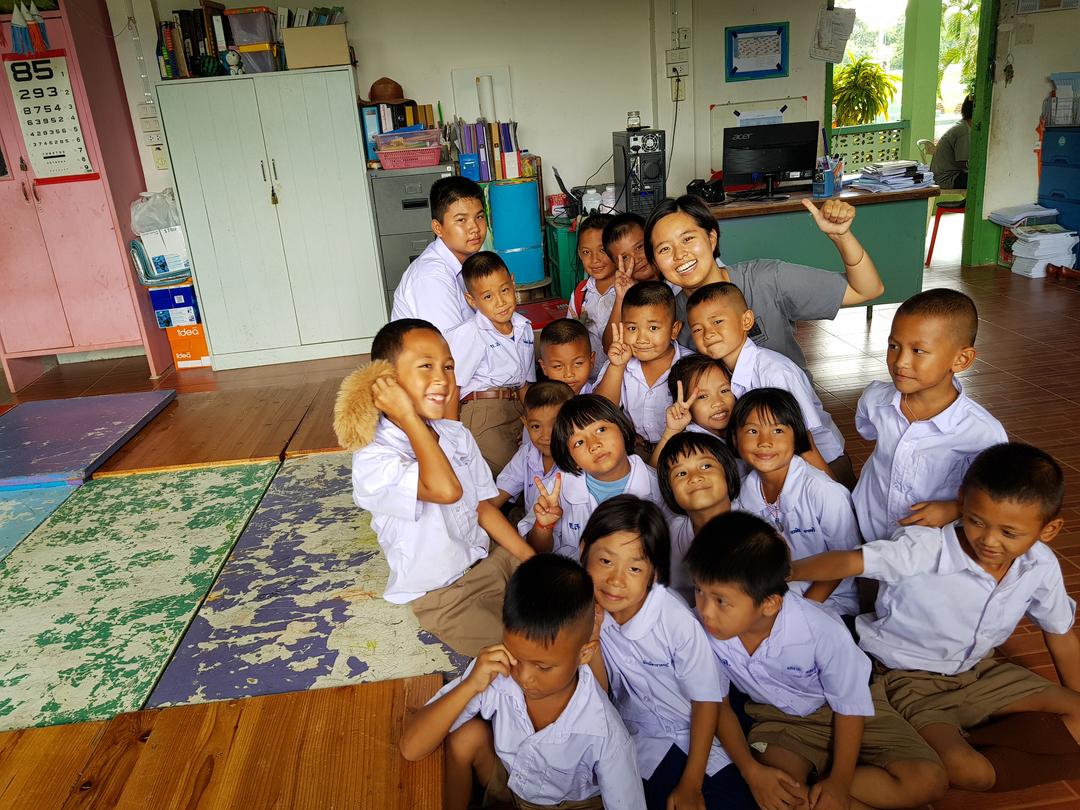
I feel like I''ve become more grounded. When you''re at a volunteer site you have a lot more time compared to Korea. You get more time to think alone, and by talking with the other volunteers I realized the most about myself — parts of myself I didn''t know. I wonder what would have happened if I hadn''t gone.
[Overseas Volunteering/Extracurricular] Enjoyable English teaching volunteer activity in Chiang Rai, Thailand with international friends Seoneul — gap year participant (25, job seeker) / 12-week gap year |
# "English teaching volunteer work," my bucket-list item where you truly give to others what you''ve learned
Hello, I''m Seoneul, 25 years old. I graduated from university last December. I completed a 12-week English teaching volunteer program in Chiang Rai, Thailand and have returned.
I went to Chiang Rai, Thailand. I chose Thailand because I''d always been interested in it. I have Thai friends, and through them I became interested. I also really like Thai food (haha), and many people around me travel there, but I realized I didn''t know much about the country itself. I wanted to learn more.
In Thailand, I taught English to children.English teaching volunteering had always been one of the bucket-list items I wanted to try. It''s really about giving to others what you''ve learned. I think I just vaguely thought it was "cool."
I wasn''t particularly worried about staying abroad for a long time. Rather, I was concerned about being in a country I''d never been to—Thailand—in the special environment of volunteering, and for a fairly long period of three months. But more than anything, my biggest worry was, "Will I be able to do it well?"
Is it okay to go volunteering instead of preparing for a job? Will I be able to do well there? Those were my worries. I thought about that right up until just before I left. Looking back now, it wasn''t a very meaningful concern though!
I took my time preparing for departure. First, I read the orientation materials sent by Korea Gap Year and searched the internet. For vaccinations, when they told me which shots to get, I got them as instructed. It''s hard to get all the shots at once, so I organized what I needed in advance and checked things off one by one.
I packed my things, and when I had questions during the process I emailed the coordinator. I also received all the important documents by email. At first glance it seemed like there was a lot to do,but if you follow the manual provided by the Korea Gap Year coordinator, it''s not as complicated as it seems.
The orientation before leaving for the site was especially helpful. I had a Skype orientation with the coordinator, and I''m really glad I did.There were many things I would have gone without knowing if I hadn''t done it. I received various pieces of advice and I think I was better prepared mentally.
# Leaving for a gap year to overcome the confusing period after graduating from college!
The goal of my gap year was to observe myself.Rather than needing a major life change, I began to wonder whether the versions of myself I knew were all there was to me. Could I really only be that?
I started with a Korea Gap Year consultation, and through that counseling I realized, "Ah, I have some emotional baggage." I thought that the way I see myself might not be whole and could be distorted. That made me curious about my true self—what other sides I might have—and that''s how I ended up going to Thailand.
After graduating university, a confusing period came. Even though I''m an adult, I didn''t know what I truly wanted or where I should be heading.So far I had been steadily doing what society expects—studying and going to university—and now it''s time to get a job, but I wasn''t sure if that was really right for me.
Who am I? What do I want and what am I good at? Should I just start earning money first and think about it later? If so, why do so many people return to square one even after getting a job, asking "I don''t really know what I want"? I felt I needed to be more careful before committing to work.
* For Seoneul, who worried a lot about herself and her career, daily one-on-one personalized missions for self-reflection, new perspectives, and challenges were provided, and a gap year notebook to reflect and make plans was also given.
# The children who genuinely loved us and the international friends who shared diverse values
A typical day: breakfast at 8, announcements at 8:30, and around 9 we leave the volunteer dorm for school. Classes start around 9:30–10, we have morning classes, eat lunch, and then go to afternoon classes. Afternoon classes usually finish around 3.
After finishing afternoon classes and returning, we hold a meeting. We evaluate how well the classes went: which parts the kids understood well, which parts they didn''t, how they reacted to a certain game—even small things—and discuss how to run the class better next time.
After that we prepare for the next day''s classes. Then we have dinner at 5, and if there are unfinished tasks we finish them afterward, but usually there''s nothing left to do by then. So I mostly rested, played board games or card games with the kids, put on music, and wrote in my diary.
At the school, classes run from Tuesday afternoon through Wednesday, Thursday, Friday, and Saturday morning. We rest on Saturday afternoon, Sunday, and Monday, and return to school on Tuesday.
My gap year was really... great. I learned so much about aspects of myself I didn''t know. That was my goal when I started my gap year—to observe myself. I discovered many new things about myself in Thailand.
Thailand is a truly charming country. People are kind. The nickname ''Land of Smiles'' is well deserved. Whether I go to the market or to school, people always smile at me as a foreigner.
What comes to mind when I think about volunteering is, first and foremost, the children! Teaching the kids. Thai students tend to have a lot of respect for their teachers. We taught at several schools, and even if you''re a teacher who only sees them once a week...They treated us sincerely and loved us. Later I became attached, and saying goodbye was difficult.
One child I remember couldn''t concentrate in class every time. It wasn''t that they couldn''t keep up with the lessons, but that the lessons were too easy and they were bored. I couldn''t just tailor everything for that one child, so I had a moment of doubt, thinking, ''Am I doing this right?''
But that child, by the last month, would open their arms and hug me every time they saw me. They didn''t want to leave my side. From the moment I entered class they would call me and stick close, and it was really touching. I received so much love.
In a way, we volunteers were kind of makeshift, a bit sloppy teachers, but the children accepted and liked us just as we were. Simply because we were teachers.
Another thing: the volunteer friends were so precious! You don''t often get the chance to meet people from many countries in one place. With friends who had such varied experiences, we were so different, came from such different places, yet we shared very similar worries.
It felt like we grew closer by sharing things like ''You have that worry too'' or ''You came to volunteer with that kind of thought.'' Especially...I spent three months and met friends from many countries, and each time my eyes were opened and I learned to be more humble.
# The me who changed noticeably before and after my gap year — what if I hadn''t gone!
To future ''gappers'' who will come here, I want to emphasize the importance of English!!!! You can never emphasize English enough. We won''t just be teaching in English or using it only for necessary communication, right? While eating with local staff and volunteers we share our interests, communicate, hang out together, joke around, and talk about worries. But that''s all in English. All English.
When I say being good at English, I mean confidence more than fluency. It means not being afraid to use English!I''ve seen many non-native English speakers who, even if not fluent, have no hesitation about speaking. Their English grammar might be all wrong, but they just speak without restraint. Those friends make friends easily and without fear. You should be able to express your thoughts confidently.
Looking at myself, I changed noticeably before and after the gap year.I guess I came to reflect on myself more?I used to have many negative thoughts about myself. I felt like I wasn''t good enough at anything, like I had no goals, and wondered why I was so sensitive and full of complaints; I just thought, ''I must be that kind of person.''
However, living at the volunteer site broke those fixed self-images. The newly discovered me liked kids more than I thought, found education rewarding, was responsible, got along well with people, and smiled a lot. Also, I used to feel self-loathing because I had no goals, but after going to Thailand, my obsessive fixation about having goals somewhat collapsed. I also picked up my own notions and perspectives.
I feel stronger and more grounded. At the volunteer site you have a lot more time compared to Korea.I had more time to think alone, and through talking with fellow volunteers I realized the most about myself—parts I didn''t know. I keep thinking, ''What would have happened if I hadn''t gone?''
Lastly, what I want to say is, ''Just give it a try''.
It''s such a cliché and everyone has different worries and thoughts, but sometimes you need to close your eyes and take the plunge. However! If you decide to challenge yourself, then prepare properly before you go.
Above all, your mindset toward change is important. If you ''challenge'' yourself without being ready to change, you''re likely to think, ''Why am I the same? I thought coming here would solve everything, so why don''t I see any change?'' First of all...1) Decide to go; 2) After that, prepare thoroughly and meticulously; 3) that preparation process is about getting yourself ready to ''let yourself be changed.''—something like that.
# My personal gap year tips
(How to get there)
Meet the person in charge who comes to pick you up at the airport.
(Language)
Brush up on conversational English. It''s very helpful to go without fear of foreigners. Listening to a lot of music from the iTunes top charts helps when hanging out with the volunteers.
(Accommodation)
It''s a very nature-friendly place.
(Meals)
They serve rice with side dishes every day, and fruit is provided twice a day! The main dishes are the spicy and salty side dishes typical of Thailand.
I brought a small bottle of sesame oil and sometimes, when I had no appetite, I mixed it with soy sauce and egg — it tasted heavenly.
(What to bring)
Be sure to bring mosquito-repellent bracelets, mosquito-repellent spray, and Vermuri (insect repellent)! You''ll also need pants that mosquitoes have a hard time getting through, like sweatpants or jeans. A small laundry net is useful for washing underwear.
Rather than just one general cold medicine, it''s convenient to bring remedies for specific symptoms like runny nose, headache, sore throat, and fever. August to October is a season when it''s easy to catch a cold. The accommodation pillows are a bit high, so if you''re staying more than a month it''s good to bring your own pillow. I managed with the accommodation''s pillow though!
And never bring malaria medication. It''s expensive (about 3,000 won per pill) and unnecessary. You don''t need a sleeping bag either. There was only one time I needed one, and I borrowed it from the volunteer accommodation for 3,000 won.
Read the orientation materials carefully, and be sure to attend the orientation — it will be very helpful!
My gap year was
Experience★★★★★
A once-in-a-lifetime experience.
Learning ★★★★★
I never expected to learn so much in three months.
Environment★★★☆☆
There are especially many cars and a lot of dust in town. The facilities are livable, but it takes time to adapt.
Safety★★★★☆
The public safety is good, but be careful in the surrounding areas (unpaved roads, motorcycles, street animals).
Leisure★★★★☆
On weekdays you''re surprisingly busy and there''s not much to do, but on weekends you can go out and explore various places.






 Home
Home