Projects
|
FAQ
|
Announcements



#Gained confidence, overcoming low self-esteem #A great sense of accomplishment and a special experience #A youthful time in my twenties; a feeling of pride

[Overseas volunteering/extracurricular] Enthusiastically doing environmental conservation volunteer work in New Zealand''s nature with friends from around the world Choi In-gu, gap year participant (gapper) (26, on leave from school) / 2-week gap year
|
# Chose New Zealand volunteer work because I thought a twenty-something with no overseas volunteer experience would regret it too much

Hello. My name is Choi In-gu. I''m a 26-year-old male university student. I took a half-semester leave of absence in 2018 and spent a gap year in New Zealand from 6/1 to 6/15. Before the gap year I had no overseas experience at all and my English was limited to a TOEIC score of 880 with zero practical English sense.
Also, I usually dislike trying new things and prefer staying at home. I''m rather lazy. In short, I''m quite timid haha. So when people around me first heard about my gap year plan, they worried a lot. I kept agonizing over it until about three weeks before, but I ultimately returned safely, so I''m leaving this account~
The reason I joined the project was that I really wanted to try overseas volunteering. I applied a lot for volunteer programs aimed at university students, but I was always eliminated in the first round. Even two weeks before my gap year started, I failed to get into another extracurricular program and then departed.I chose volunteer work because I thought I''d regret it too much to be in my twenties without overseas volunteer experience.
Also, I think I was most attracted to the idea of New Zealand''s nature.I had the perception ''New Zealand = a land of great nature.'' I also thought it was affordable and chose it because I''d heard many Koreans live in New Zealand.That was one of the reasons.
And I''m confident with physical work, so I thought I could carry out the volunteering without problems. I also wanted to live with foreign friends.

I volunteered for two weeks and then traveled alone for one week, staying in New Zealand for a total of three weeks. Before departure I was really, reaaally nervous. It was my first trip abroad and I had to go alone. I couldn''t speak English.
Sometimes I even felt like I was about to enlist in the military — I was extremely nervous. What if I couldn''t pass New Zealand immigration, what if I got robbed, what if I faced racial discrimination, what if I got injured, etc… Actually, even after departing that tension and worry didn''t disappear. Most of the time while I was away from Korea was filled with anxiety and worry.
But looking back now,I think I was just naturally fearful and couldn''t help it. Everything is hard at first. And because I worried and was cautious a lot, I think I was able to complete the three weeks safely.
For pre-departure preparation I referred to many things such as the information packet sent by Korea Gap Year, the local organization''s website, internet searches, New Zealand travel guides, and acquaintances.I prepared by dividing tasks into departure/accommodation/moving to meeting place/volunteer supplies/individual travel/arrival. In particular, be sure to check the packing list on the local organization''s website.You should.
I also checked routes and times using Google Maps as I moved. I referred to YouTube a lot as well. Actually, I wanted to contact people who had been there to ask questions, but that wasn''t easy. I should have studied English, but because I was preparing for other exams I hardly did. Conversation doesn''t improve overnight; trying to study made me nervous and unfocused, so I just practiced the phrases I thought I would need. Still, I returned without major problems.
# Daily routine on site, and memorable Belgian, German, and French teammates

The project proceeds by changing accommodations between weekdays and weekends. First,on Friday we have a short orientation at the Auckland organization''s office and fill out paperwork, then move to the accommodation with the team leader.It is about an hour away from downtown Auckland. There we live very freely with team members until Monday morning. You can go on an individual trip during this time! No one interferes; drinking and smoking are allowed!
On Monday morning we head to the volunteer site to begin volunteering in earnest. Because we have to move accommodations, we try to take all our luggage with us.We stay at the volunteer site for five weekdays and carry out volunteer activities.
Briefly, the daily schedule is
8:00 Individual volunteer preparation complete, board the transport
8:30 – 12:00 Volunteer work
12:20-13:15 Return to accommodation, individual lunch and rest (sometimes barbecue provided)
13:30-16:00 Volunteer work
16:00- Free time, dinner, sleep
I usually woke up at 7:20 and went to bed around 23:00.
And on Fridays we moved back to the Titirangi accommodation to spend the weekend.
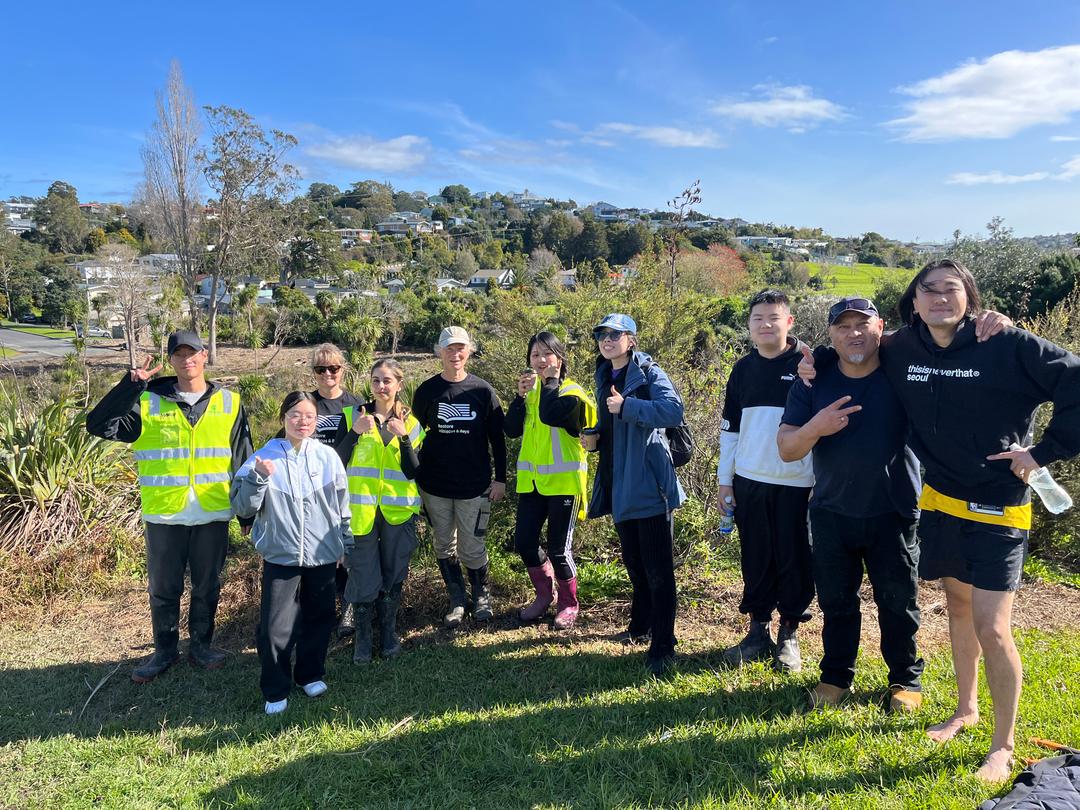
In detailIn my case, we moved saplings raised by the group to planting sites and planted them, then cleaned and organized equipment, or did tasks like pruning branches of large trees.I did those things. It''s mostly just physical labor. The park is huge so there''s a lot of driving time, and if you''re tired you can rest freely while working.

During the project I met many people, but the teammates I lived with are the most memorable. I was in a team with three friends from Belgium, Germany, and France; I was the only Asian and not very good at English, but they treated me very kindly. AndThe German friend was 19 and confidently said he came to New Zealand for a gap year, which was very impressive.In our country that''s the age when people are intensely studying for the college entrance exam...
And I once cooked Buldak-bokkeum-myeon (spicy chicken noodles) for my foreign teammates — seeing the foreign reactions I''d only seen on YouTube in person made me proud and happy ^^. During the gap year project I was the only Asian, but there was no racism or unpleasant experiences at all. On the contrary, many people greeted me first saying hello lol.
Living with friends from other countries, we cooked for each other, watched movies together, talked about soccer, and I was able to meet good friends.


[Overseas volunteering/extracurricular] Enthusiastically doing environmental conservation volunteer work in New Zealand''s nature with friends from around the world Choi In-gu, gap year participant (gapper) (26, on leave from school) / 2-week gap year
|
# Chose New Zealand volunteer work because I thought a twenty-something with no overseas volunteer experience would regret it too much
Hello. My name is Choi In-gu. I''m a 26-year-old male university student. I took a half-semester leave of absence in 2018 and spent a gap year in New Zealand from 6/1 to 6/15. Before the gap year I had no overseas experience at all and my English was limited to a TOEIC score of 880 with zero practical English sense.
Also, I usually dislike trying new things and prefer staying at home. I''m rather lazy. In short, I''m quite timid haha. So when people around me first heard about my gap year plan, they worried a lot. I kept agonizing over it until about three weeks before, but I ultimately returned safely, so I''m leaving this account~
The reason I joined the project was that I really wanted to try overseas volunteering. I applied a lot for volunteer programs aimed at university students, but I was always eliminated in the first round. Even two weeks before my gap year started, I failed to get into another extracurricular program and then departed.I chose volunteer work because I thought I''d regret it too much to be in my twenties without overseas volunteer experience.
Also, I think I was most attracted to the idea of New Zealand''s nature.I had the perception ''New Zealand = a land of great nature.'' I also thought it was affordable and chose it because I''d heard many Koreans live in New Zealand.That was one of the reasons.
And I''m confident with physical work, so I thought I could carry out the volunteering without problems. I also wanted to live with foreign friends.
I volunteered for two weeks and then traveled alone for one week, staying in New Zealand for a total of three weeks. Before departure I was really, reaaally nervous. It was my first trip abroad and I had to go alone. I couldn''t speak English.
Sometimes I even felt like I was about to enlist in the military — I was extremely nervous. What if I couldn''t pass New Zealand immigration, what if I got robbed, what if I faced racial discrimination, what if I got injured, etc… Actually, even after departing that tension and worry didn''t disappear. Most of the time while I was away from Korea was filled with anxiety and worry.
But looking back now,I think I was just naturally fearful and couldn''t help it. Everything is hard at first. And because I worried and was cautious a lot, I think I was able to complete the three weeks safely.
For pre-departure preparation I referred to many things such as the information packet sent by Korea Gap Year, the local organization''s website, internet searches, New Zealand travel guides, and acquaintances.I prepared by dividing tasks into departure/accommodation/moving to meeting place/volunteer supplies/individual travel/arrival. In particular, be sure to check the packing list on the local organization''s website.You should.
I also checked routes and times using Google Maps as I moved. I referred to YouTube a lot as well. Actually, I wanted to contact people who had been there to ask questions, but that wasn''t easy. I should have studied English, but because I was preparing for other exams I hardly did. Conversation doesn''t improve overnight; trying to study made me nervous and unfocused, so I just practiced the phrases I thought I would need. Still, I returned without major problems.
# Daily routine on site, and memorable Belgian, German, and French teammates
The project proceeds by changing accommodations between weekdays and weekends. First,on Friday we have a short orientation at the Auckland organization''s office and fill out paperwork, then move to the accommodation with the team leader.It is about an hour away from downtown Auckland. There we live very freely with team members until Monday morning. You can go on an individual trip during this time! No one interferes; drinking and smoking are allowed!
On Monday morning we head to the volunteer site to begin volunteering in earnest. Because we have to move accommodations, we try to take all our luggage with us.We stay at the volunteer site for five weekdays and carry out volunteer activities.
Briefly, the daily schedule is
8:00 Individual volunteer preparation complete, board the transport
8:30 – 12:00 Volunteer work
12:20-13:15 Return to accommodation, individual lunch and rest (sometimes barbecue provided)
13:30-16:00 Volunteer work
16:00- Free time, dinner, sleep
I usually woke up at 7:20 and went to bed around 23:00.
And on Fridays we moved back to the Titirangi accommodation to spend the weekend.
In detailIn my case, we moved saplings raised by the group to planting sites and planted them, then cleaned and organized equipment, or did tasks like pruning branches of large trees.I did those things. It''s mostly just physical labor. The park is huge so there''s a lot of driving time, and if you''re tired you can rest freely while working.
During the project I met many people, but the teammates I lived with are the most memorable. I was in a team with three friends from Belgium, Germany, and France; I was the only Asian and not very good at English, but they treated me very kindly. AndThe German friend was 19 and confidently said he came to New Zealand for a gap year, which was very impressive.In our country that''s the age when people are intensely studying for the college entrance exam...
And I once cooked Buldak-bokkeum-myeon (spicy chicken noodles) for my foreign teammates — seeing the foreign reactions I''d only seen on YouTube in person made me proud and happy ^^. During the gap year project I was the only Asian, but there was no racism or unpleasant experiences at all. On the contrary, many people greeted me first saying hello lol.
Living with friends from other countries, we cooked for each other, watched movies together, talked about soccer, and I was able to meet good friends.
Capturing the growth journeys
of our participants.

 Home
Home


Take a step out of your comfort zone.
Challenge yourself for your own sake.
Feel complete freedom.
Be happy.