Projects
|
FAQ
|
Announcements



#Listening and speaking became more natural #Tips for planning a trip to the UK #Satisfied with dormitory life

# My personal gap year tips for prospective participants - Seo Ji-won, a gap-yearper
1. Strongly recommend the language school dormitory
To get straight to the point, I strongly recommend the language school''s dormitory.Let me briefly explain the dormitory. <Room, bathroom> Single rooms don''t have private bathrooms, so you have to use shared ones; if you want a bathroom (shower) inside the room, only a double room (two people per room) is available. The cheapest option is the double room, where the bathroom (shower) is shared.
I chose the double room with a bathroom inside. Don''t expect a bathroom like in Korea; it''s more like a small boarding-room style (gosiwon). I lived in a gosiwon in college and experienced it on several trips, so I adapted quickly. (A shower booth, a toilet, that''s it — that kind of bathroom.)
<Shared kitchen> There are about five or six sinks and gas stoves in a row; dishes and pots are used communally, and various seasonings are provided for shared use. There''s an oven so you can bake things like pizza, and I remember there being three fridge compartments for chilling and two for freezing? They assign you a specific compartment you can use. They also assign storage space, so you can use it without worry.
I hadn''t cooked at all in Korea, butbecause buying food in the UK is really expensive, I found myself at some point preparing simple dishes with rice and taking packed lunches. It''s much cheaper to bring your own lunch, so strongly recommend. (I''ll talk about this again later.)

<Residence advantage: a situation where you have no choice but to keep using English> Homestay is of course similar, but among friends who did homestays there were two clear disadvantages.
First, transportation costs are higher.
The dorm is located in Zone 2, so even with a travelcard it''s about £33 per week, £127 per month or so. But homestays are often in Zone 4, so the weekly or monthly travelcard costs are much higher. (I don''t remember the weekly price now, but monthly might be £160? £190?) Most of London''s tourist spots are within Zone 2, so you can get a travelcard covering Zones 1–2 and get around just fine. (If you occasionally go beyond those zones you just top up the difference.)
Therefore,While homestays may seem cheaper since they sometimes include meals, when you compare the costs including travel time and transportation to the school, you''ll see that the language school dormitory isn''t unusually expensive.
Second, it''s hard to talk with homestay families. First, there''s an age difference. Sometimes an elderly couple hosts you, sometimes a family, but it didn''t seem like there were many opportunities to have conversations — perhaps because it''s not the same nurturing culture as Korean families. You might think you''d use more English in a homestay, but think about Korean families: it''s rare to have lots of conversations with family at home. Also, if you don''t get along with the homestay family, more sensitive issues can arise.

On the other hand, the language school dormitory has the following advantages.
One.It''s located in Zone 2 so transportation is "relatively" cheaper.And with a travelcard (a kind of weekly/monthly pass) you can reach most tourist spots, so the location is really good.
Two.A 3-minute walk from Kentish Town station!!Moreover, Kentish Town is on the Northern Line which has many late-night services, so you can get home by tube even at 11 or 12. If you happen to be out until 2 or 3 AM, there are two night bus routes that stop at the bus stop two minutes from the front of the building, so there''s no need to worry.
Three.Various amenities are nearby.The supermarket and coin laundry are literally a 1-minute walk including crossing the road, the tube station is a 3–4 minute walk. If you walk a bit further down there are about five supermarkets and quite a few restaurants. There''s a pub close to the front of the building, a seemingly pretty popular venue (O''Forum?) and I recently discovered a seriously, really, incredibly tasty coffee/brunch place. Hampstead Heath is a 15-minute walk away, and if you go up there you can see central London at a glance.
Four.You can get to the language school directly by bus, or it takes 25 minutes by tube.I liked taking the double-decker bus to sightsee around town so I often took the bus, but during the morning commute there''s the usual traffic congestion so I also took the tube a lot. Of course sometimes I took the tube because I overslept. When going to the language school it''s fast to take the tube towards Bank and change at King''s Cross to the Piccadilly Line! The transfer distance is short and convenient.
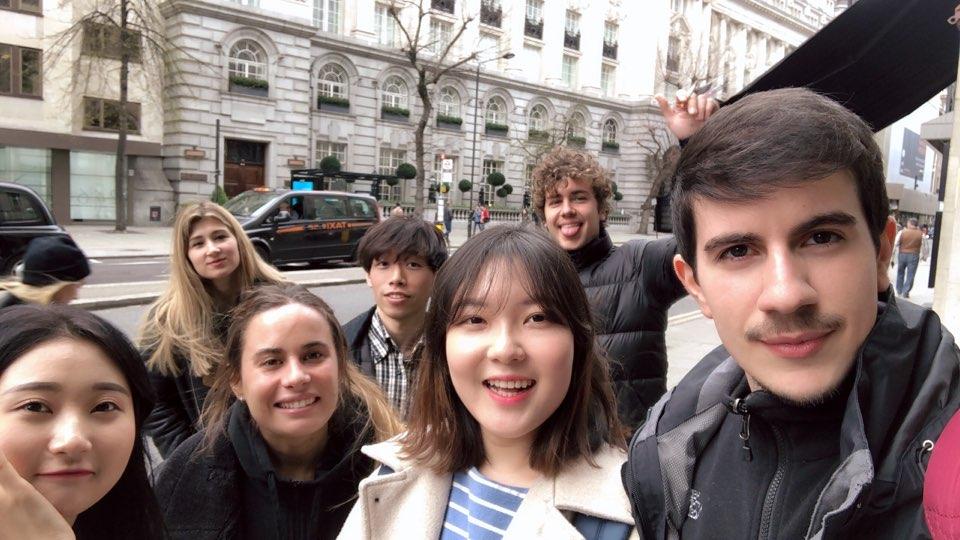
Five.You can make friends from various countries, and since those friends all attend the language school you can become closer.Making friends is always a matter of luck, like meeting a roommate, but you can meet people of many nationalities who live here, and on weekends you can cook together and become close. Koreans are often very shy and I was too, so it was a bit difficult at first, but I gradually got used to their culture and made close friends and settled in naturally. It depends on each person''s personality, but if you take part in opportunities like sharing food in the kitchen you''ll be exposed to situations where you have to keep using English, so your listening and speaking will become more natural.

2. If you''re planning a trip to the UK, please make plans in advance and buy your tickets first.
The UK has a lot of great tourist spots. The places I''ve been to—Windsor, Oxford, Cambridge, the Cotswolds, Greenwich, Bath—are all lovely, and it''s very convenient for traveling on to Europe, like Paris or Belgium.
But one really important thing is that whether it''s buses (coach, Megabus, etc.), trains, Eurostar, or flights, you should buy tickets at least three weeks in advance to get cheaper prices.Sometimes coaches can be reasonably priced even a week before, but I strongly recommend booking tickets 3–4 weeks ahead. I''m writing this with three days left of my gap year, and as someone hurriedly visiting places I haven''t been to, I deeply regret not booking tickets in advance.
I went to Belgium today and it cost me over £100 for a round trip. If I had booked 3–4 weeks earlier I could have gotten it for under £50 — I''m such an idiot. From London you can go to nearby areas, outskirts, or any European country, so just make a plan for when and where you''ll go and book the tickets first; I strongly recommend it.

3. Bringing packed meals will save you a lot on food expenses.
Ingredients sold at supermarkets are really cheap.Not only vegetables and fruits, but meat is cheap... oh my goodness!! So from simple sandwiches to a rice meal with a few side dishes (I often make rolled omelettes), if you pack and carry them you''ll really save a ton on food.
Where to eat is the question, but most Brits, ''when the weather''s nice'', go to parks and sit anywhere to eat. Many supermarkets like Sainsbury''s or Tesco sell lunch-type foods like sandwiches and even simple sushi, and people take them out to the park to sit and eat.
If the weather isn''t good it''s a bit tricky, but the language school has a ''student room'', so it''s fine to eat there!! Unless it''s extremely cold or pouring rain, there''s usually somewhere you can sit and eat. There are even two parks within a five-minute walk from the school, so don''t worry! (If you check near the school on Google, you can find Bloomsbury Square Garden and Lincoln''s Inn Fields.)

That''s about all I can think of for now. I mostly ended up writing about everyday life.This will probably be most useful information for future gappers, but I don''t think these are emotional tips or advice for successfully completing a gap year.
The attitude to take toward a gap year, which you should be clear about even before coming from Korea, is ''DO''.I think the most important thing is to throw yourself into things, try them, keep at them until they work, not be shy about new things, not be socially timid, and develop a thick skin.

# My personal gap year tips for prospective participants - Seo Ji-won, a gap-yearper
1. Strongly recommend the language school dormitory
To get straight to the point, I strongly recommend the language school''s dormitory.Let me briefly explain the dormitory. <Room, bathroom> Single rooms don''t have private bathrooms, so you have to use shared ones; if you want a bathroom (shower) inside the room, only a double room (two people per room) is available. The cheapest option is the double room, where the bathroom (shower) is shared.
I chose the double room with a bathroom inside. Don''t expect a bathroom like in Korea; it''s more like a small boarding-room style (gosiwon). I lived in a gosiwon in college and experienced it on several trips, so I adapted quickly. (A shower booth, a toilet, that''s it — that kind of bathroom.)
<Shared kitchen> There are about five or six sinks and gas stoves in a row; dishes and pots are used communally, and various seasonings are provided for shared use. There''s an oven so you can bake things like pizza, and I remember there being three fridge compartments for chilling and two for freezing? They assign you a specific compartment you can use. They also assign storage space, so you can use it without worry.
I hadn''t cooked at all in Korea, butbecause buying food in the UK is really expensive, I found myself at some point preparing simple dishes with rice and taking packed lunches. It''s much cheaper to bring your own lunch, so strongly recommend. (I''ll talk about this again later.)
<Residence advantage: a situation where you have no choice but to keep using English> Homestay is of course similar, but among friends who did homestays there were two clear disadvantages.
First, transportation costs are higher.
The dorm is located in Zone 2, so even with a travelcard it''s about £33 per week, £127 per month or so. But homestays are often in Zone 4, so the weekly or monthly travelcard costs are much higher. (I don''t remember the weekly price now, but monthly might be £160? £190?) Most of London''s tourist spots are within Zone 2, so you can get a travelcard covering Zones 1–2 and get around just fine. (If you occasionally go beyond those zones you just top up the difference.)
Therefore,While homestays may seem cheaper since they sometimes include meals, when you compare the costs including travel time and transportation to the school, you''ll see that the language school dormitory isn''t unusually expensive.
Second, it''s hard to talk with homestay families. First, there''s an age difference. Sometimes an elderly couple hosts you, sometimes a family, but it didn''t seem like there were many opportunities to have conversations — perhaps because it''s not the same nurturing culture as Korean families. You might think you''d use more English in a homestay, but think about Korean families: it''s rare to have lots of conversations with family at home. Also, if you don''t get along with the homestay family, more sensitive issues can arise.
On the other hand, the language school dormitory has the following advantages.
One.It''s located in Zone 2 so transportation is "relatively" cheaper.And with a travelcard (a kind of weekly/monthly pass) you can reach most tourist spots, so the location is really good.
Two.A 3-minute walk from Kentish Town station!!Moreover, Kentish Town is on the Northern Line which has many late-night services, so you can get home by tube even at 11 or 12. If you happen to be out until 2 or 3 AM, there are two night bus routes that stop at the bus stop two minutes from the front of the building, so there''s no need to worry.
Three.Various amenities are nearby.The supermarket and coin laundry are literally a 1-minute walk including crossing the road, the tube station is a 3–4 minute walk. If you walk a bit further down there are about five supermarkets and quite a few restaurants. There''s a pub close to the front of the building, a seemingly pretty popular venue (O''Forum?) and I recently discovered a seriously, really, incredibly tasty coffee/brunch place. Hampstead Heath is a 15-minute walk away, and if you go up there you can see central London at a glance.
Four.You can get to the language school directly by bus, or it takes 25 minutes by tube.I liked taking the double-decker bus to sightsee around town so I often took the bus, but during the morning commute there''s the usual traffic congestion so I also took the tube a lot. Of course sometimes I took the tube because I overslept. When going to the language school it''s fast to take the tube towards Bank and change at King''s Cross to the Piccadilly Line! The transfer distance is short and convenient.
Five.You can make friends from various countries, and since those friends all attend the language school you can become closer.Making friends is always a matter of luck, like meeting a roommate, but you can meet people of many nationalities who live here, and on weekends you can cook together and become close. Koreans are often very shy and I was too, so it was a bit difficult at first, but I gradually got used to their culture and made close friends and settled in naturally. It depends on each person''s personality, but if you take part in opportunities like sharing food in the kitchen you''ll be exposed to situations where you have to keep using English, so your listening and speaking will become more natural.
2. If you''re planning a trip to the UK, please make plans in advance and buy your tickets first.
The UK has a lot of great tourist spots. The places I''ve been to—Windsor, Oxford, Cambridge, the Cotswolds, Greenwich, Bath—are all lovely, and it''s very convenient for traveling on to Europe, like Paris or Belgium.
But one really important thing is that whether it''s buses (coach, Megabus, etc.), trains, Eurostar, or flights, you should buy tickets at least three weeks in advance to get cheaper prices.Sometimes coaches can be reasonably priced even a week before, but I strongly recommend booking tickets 3–4 weeks ahead. I''m writing this with three days left of my gap year, and as someone hurriedly visiting places I haven''t been to, I deeply regret not booking tickets in advance.
I went to Belgium today and it cost me over £100 for a round trip. If I had booked 3–4 weeks earlier I could have gotten it for under £50 — I''m such an idiot. From London you can go to nearby areas, outskirts, or any European country, so just make a plan for when and where you''ll go and book the tickets first; I strongly recommend it.
3. Bringing packed meals will save you a lot on food expenses.
Ingredients sold at supermarkets are really cheap.Not only vegetables and fruits, but meat is cheap... oh my goodness!! So from simple sandwiches to a rice meal with a few side dishes (I often make rolled omelettes), if you pack and carry them you''ll really save a ton on food.
Where to eat is the question, but most Brits, ''when the weather''s nice'', go to parks and sit anywhere to eat. Many supermarkets like Sainsbury''s or Tesco sell lunch-type foods like sandwiches and even simple sushi, and people take them out to the park to sit and eat.
If the weather isn''t good it''s a bit tricky, but the language school has a ''student room'', so it''s fine to eat there!! Unless it''s extremely cold or pouring rain, there''s usually somewhere you can sit and eat. There are even two parks within a five-minute walk from the school, so don''t worry! (If you check near the school on Google, you can find Bloomsbury Square Garden and Lincoln''s Inn Fields.)
That''s about all I can think of for now. I mostly ended up writing about everyday life.This will probably be most useful information for future gappers, but I don''t think these are emotional tips or advice for successfully completing a gap year.
The attitude to take toward a gap year, which you should be clear about even before coming from Korea, is ''DO''.I think the most important thing is to throw yourself into things, try them, keep at them until they work, not be shy about new things, not be socially timid, and develop a thick skin.
Capturing the growth journeys
of our participants.

 Home
Home


Take a step out of your comfort zone.
Challenge yourself for your own sake.
Feel complete freedom.
Be happy.